
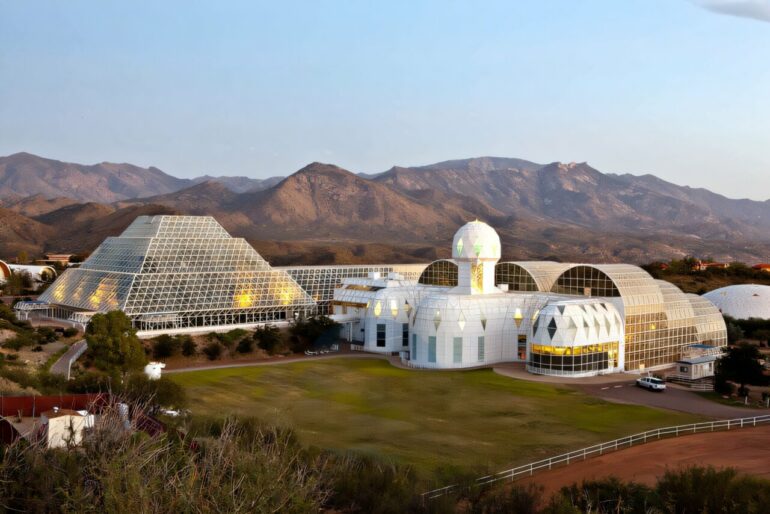
From a distance, Biosphere 2 emerges from the cacti and creosote of the Sonoran desert like a gleaming oasis, a colony of glass and bright white structures. Despite being just outside Tucson, Arizona, it looks almost like a colony on another planet.
When one of the facility’s 100,000 annual visitors steps inside, they see a whole world – from a tropical rainforest, glistening in 50 shades of green and teeming with life, to a miniature, experimental ocean. Toward the end of the tour, the visitor comes to a comparatively barren-looking experiment called the Landscape Evolution Observatory, where life is struggling to establish itself on crushed volcanic rock originally spewed from an ancient Arizonan volcano.
It is these rock slopes, where life is colonizing and transforming a tough landscape, that our team thinks are the key to humanity’s future – both on Earth and, eventually, on other worlds.
Biosphere 2 first became famous as the human experiment of the 1990s that sealed a group of eight researchers inside its 3 acres of diverse ecosystems for two long years. The goal was to experiment with the viability of a closed ecological system to maintain human life in outer space. Today, we – a global change ecologist, an astronomer and a doctoral student specializing in microbial biogeochemistry, along with our team of colleagues – have made Biosphere 2 into a test bed for understanding how life transforms landscapes, from local areas to whole planets.
We hope to use what we learn to help preserve biodiversity, access to fresh water and food security. To address these issues, we must understand how soil, rocks, water and microbes together drive the transformation of landscapes, from local to planetary scales.
Beyond Earth, these same principles apply to the challenge of terraformation: the science of rendering other worlds habitable.
How life on Earth affects the Earth
Life doesn’t just sit on the Earth’s surface. Organisms profoundly affect the planet’s geology, as well as the atmosphere’s composition. Biology can transform barren environments into habitable ecosystems.
This happened with the evolution of cyanobacteria, the first microscopic organisms to use oxygen-producing photosynthesis. Cyanobacteria pumped oxygen into the atmosphere 2 billion to 3 billion years ago.

Atmospheric oxygen, in turn, enabled a new supercharged metabolism of life called aerobic, or oxygen-using, respiration. Aerobic respiration produced so much energy that it became the dominant way for organisms to make the energy needed for life, eventually making multicellular life possible.
Cyanobacteria allowed organisms to take in oxygen and produce energy, which made more complex life possible.
In addition, the oxygen produced by photosynthesizing cyanobacteria also made its way to the upper atmosphere, forming another kind of oxygen known as ozone, which, by…

