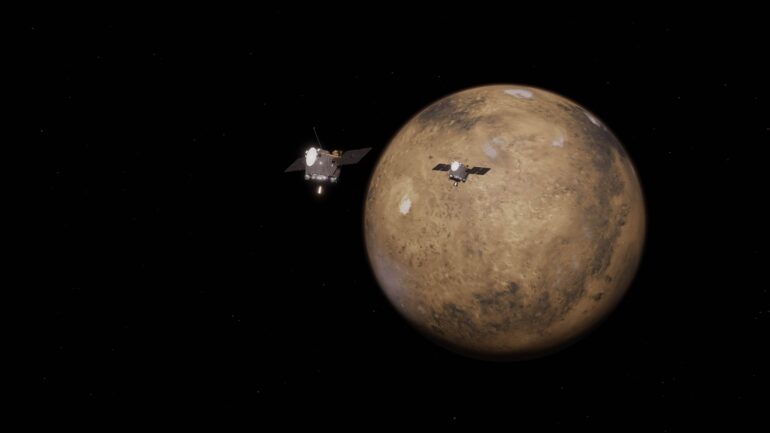
After a yearslong series of setbacks, NASA’s Escape and Plasma Acceleration and Dynamics Explorers, or ESCAPADE, mission has finally begun its roundabout journey to Mars.
Launched on Nov. 13, 2025, aboard Blue Origin’s New Glenn rocket, ESCAPADE’s twin probes will map the planet’s magnetic field and study how the solar wind – the stream of charged particles released from the Sun – has stripped away the Martian atmosphere over billions of years.
When I was a doctoral student, I helped develop the VISIONS camera systems onboard each of ESCAPADE’s spacecraft, so I was especially excited to see the successful launch.
But this low-cost mission is still only getting started, and it’s taking bigger risks than typical big-ticket NASA missions.
ESCAPADE is part of NASA’s Small Innovative Missions for Planetary Exploration, or SIMPLEx, program that funds low‑cost, higher‑risk projects. Of the five SIMPLEx missions selected so far, three have failed after launch due to equipment problems that might have been caught in more traditional, tightly managed programs. A fourth sits in indefinite storage.
ESCAPADE will not begin returning science data for about 30 months, and the program’s history suggests the odds are not entirely in its favor. Nonetheless, the calculus goes that if enough of these missions are successful, NASA can achieve valuable science at a reduced cost – even with some losses along the way.
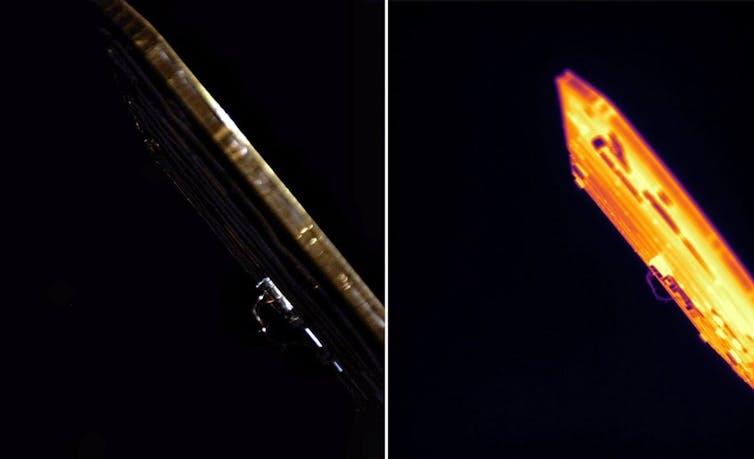
First light taken Nov. 21, 2025, from the VISIONS camera aboard Gold, one of NASA’s ESCAPADE spacecraft, showing the side of a solar panel. The left image is the visible-light camera, sensitive enough to image Mars’ green aurora. The right image is from an infrared camera and shows temperature differences, from warmer (yellow and orange) to cooler (purple and black), that can distinguish geologic features on Mars.
NASA/UCB-SSL/RL/NAU-Radiant/Lucint
Lower cost, higher risk
NASA classifies payloads on a four‑tier risk scale, from A to D.
Class A missions are the most expensive and highest priority, like the James Webb Space Telescope, Europa Clipper and the Nancy Grace Roman Space Telescope. They use thoroughly proven hardware and undergo exhaustive testing.

ESCAPADE is at the other end. It’s a class D mission, defined as having “high risk tolerance” and “medium to low complexity.”
Of the 21 class D missions that have launched since the designation was first applied in 2009, NASA has not had a single class D mission launch on schedule. Only four remained under budget. Four were canceled outright prior to launch.
ESCAPADE, which will have cost an estimated US$94.2 million by the end of its science operations in 2029, has stayed under the $100 million mark through a series of cost‑saving choices. It has a small set of key instruments, a low spacecraft mass to reduce launch costs, and extensively uses generic commercial components instead of custom…