
The questions of how humankind came to be, and whether we are alone in the universe, have captured imaginations for millennia. But to answer these questions, scientists must first understand life itself and how it could have arisen.
In our work as evolutionary biochemists and protein historians, these core questions form the foundation of our research programs. To study life’s history billions of years ago, we often use clues called molecular “fossils” – ancient structures shared by all living organisms.
Recently, we discovered that an important molecular fossil found in an ancient protein family may not be what it seems. The dilemma centers, in part, on a simple question: What does it mean if a simple molecular structure – the fossil – is found in every single organism on Earth? Do molecular fossils point to the seeds that gave rise to modern biological complexity, or are they simply the stubborn pieces that have resisted erosion over time? The answers have far-reaching implications for how scientists understand the origins of biology.
Follow the phosphorus to follow life
Life is made of many different building blocks, one of the most important of which is the chemical element phosphorus. Phosphorus makes up part of your genetic material, powers complex metabolic reactions and acts as a molecular switch to control enzymes.
Phosphorus compounds – specifically a charged form called phosphate – have a number of unique chemical properties that other biological compounds cannot match. In the words of the pioneering organic chemist F.H. Westheimer, they are chemically able to “do almost everything.”
Their unique combination of stability, versatility and adaptability is why many researchers argue that following phosphorus is key to finding life. The presence of phosphorus both close to home – in the ocean or on one of Saturn’s moons – and in the farthest reaches of our galaxy is strong evidence for the potential for life beyond Earth.
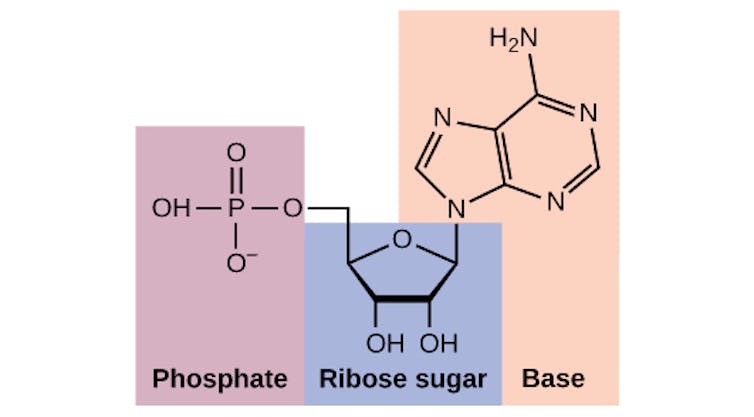
Phosphate is part of many essential biological molecules, including the building blocks of DNA.
Charles Molnar and Jane Gair, CC BY-SA
If phosphorus is so critical to life, how did early biology predating cells first use it?
Today, biological organisms are able to make use of phosphates through proteins – molecular machines that regulate all aspects of life. By binding to proteins, phosphates regulate metabolism and cellular communication, and they serve as a source of cellular energy.
Further, the process of phosphorylation, or adding a phosphate group to a protein, is ubiquitous in biology and allows proteins to perform functions their individual building blocks cannot. Without proteins, the existence of organisms such as bacteria and humans may not be possible.
Given how essential phosphorus is to life, scientists hypothesize that phosphate binding was among the first biological functions to emerge on Earth. In fact, current…