

Parents of young children probably recognize the hectic mornings filled with reminding the kids to eat breakfast, brush their teeth and put on their shoes – and hurry up, you’re gonna be late!
Most little kids can’t manage these morning routines on their own because they lack the necessary executive function: the set of skills that affect how people make purposeful decisions that align with their goals. It’s these skills that allow you to set and pursue short-term goals, such as making breakfast, and long-term goals, such as pursuing a successful career.
Early childhood marks a period of significant development in executive function ability. Research shows that children with better executive function tend to grow up to be financially stable, healthy and productive adults. For this reason, many psychologists and educators are seeking ways to help kids develop these skills in early childhood, potentially setting them up for later success.
As important as these skills are, though, attempts to understand where they come from and how to train them have been mostly unsuccessful – until now.
We are psychologists at the University of Tennessee in the Attention, Brain and Cognition Lab, and our recent study provides new insights into how executive function develops.
Where previous attempts failed
There have been many attempts to teach children executive function, in hopes that improvements will translate to other cognitive skills. But these have largely been unsuccessful for two reasons.
First, while children in these experiments learned specific tasks, they didn’t learn skills that would translate to the real world. It’s like how studying for your ACT may make you better at taking the ACT but not necessarily better at the skills you need for your future job.
Second, on the more technical side, measuring brain activity in young children is notoriously difficult. MRIs are too restrictive – not to mention scary – to be used on children while they perform tasks.
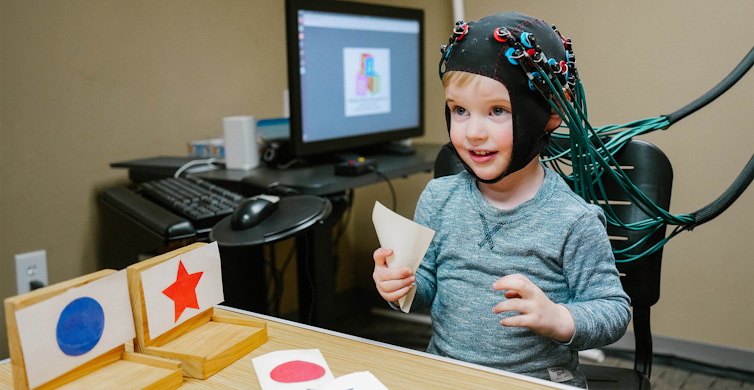
We fitted children in our lab with lightweight caps with near-infrared sensors in them to measure which parts of the brain were active during the sorting tasks.
University of Tennessee, Knoxville
New tools offer new insights
Many researchers now use a more child-friendly neuroimaging machine called functional near-infrared spectroscopy, which involves placing sensors on a child’s head – typically in the form of a lightweight cap – to track their brain function. This laser system monitors blood flow in the outer layer of the brain, known as the cortical surface. Blood flow indicates neural activity and reveals areas of the brain that are most busy.
This technology is a step in the right direction, but it’s still difficult to ensure that the sensors are placed in exactly the same way from one session to the next, and from one kid to the next. This challenge is particularly pronounced in longitudinal studies, because…