Near the equator, the Sun hurries below the horizon in a matter of minutes. Darkness seeps from the surrounding forest. Nearly 10,000 years ago, at the base of a mountain in Africa, people’s shadows stretch up the wall of a natural overhang of stone.
They’re lit by a ferocious fire that’s been burning for hours, visible even to people miles away. The wind carries the smell of burning. This fire will linger in community memory for generations − and in the archaeological record for far longer.
We are a team of bioarchaeologists, archaeologists and forensic anthropologists who, with our colleagues, recently discovered the earliest evidence of cremation – the transformation of a body from flesh to burned bone fragments and ashes – in Africa and the earliest example of an adult pyre cremation in the world.

The pyre was found under a giant boulder near the base of Mount Hora. The site is in Malawi, which is outlined in black within the Zambezian forest (colored green) on the map of Africa.
Jessica Thompson and Natural Earth
It’s no easy task to produce, create and maintain an open fire strong enough to completely burn a human body. While the earliest cremation in the world dates to about 40,000 years ago in Australia, that body was not fully burned.
It is far more effective to use a pyre: an intentionally built structure of combustible fuel. Pyres appear in the archaeological record only about 11,500 years ago, with the earliest known example containing a cremated child under a house floor in Alaska.
Many cultures have practiced cremation, and the bones, ash and other residues from these events help archaeologists piece together past funeral rituals. Our scientific paper, published in the journal Science Advances, describes a spectacular event that happened about 9,500 years ago in Malawi in south-central Africa, challenging long-held notions about how hunter-gatherers treat their dead.


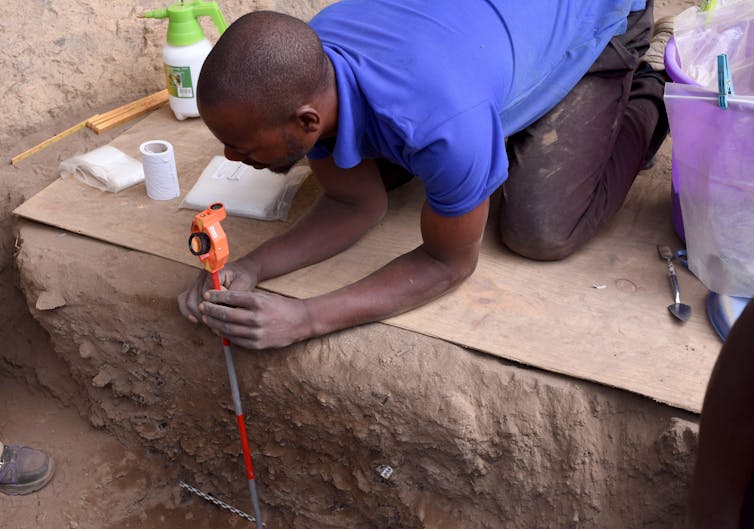
Excavators standing at the depth of the pyre at the Hora 1 site in northern Malawi.
Jessica Thompson
The discovery
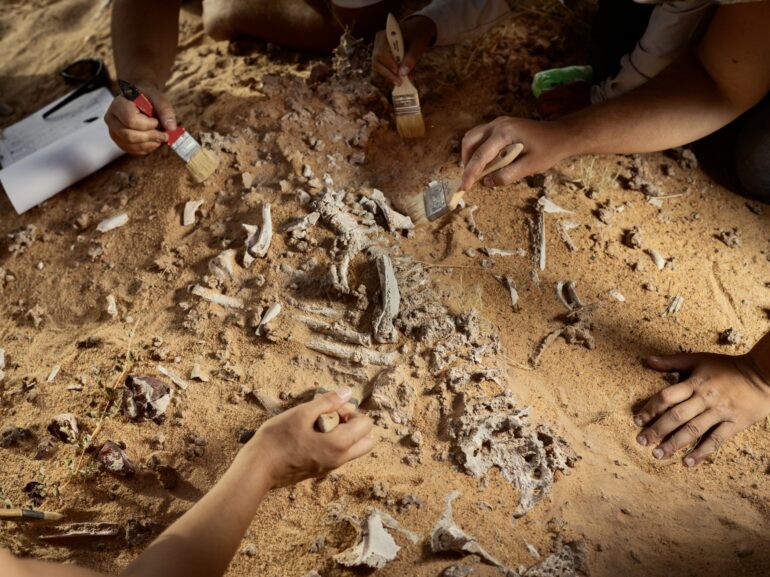
At first it was just a hint of ash, then more. It expanded downward and outward, becoming thicker and harder. Pockets of dark earth briefly appeared and disappeared under trowels and brushes until one of the excavators stopped. They pointed to a small bone at the base of a 1½-foot (0.5-meter) wall of archaeological ash revealed under a natural stone overhang at the Hora 1 archaeological site in northern Malawi.
The bone was the broken end of a humerus, from the upper arm of a person. And clinging to the very end of it was the matching end of the lower arm, the radius. Here was a human elbow joint, burned and fractured, preserved in sediments full of debris from the daily lives of Stone Age hunter-gatherers.
We wondered whether this could be a funeral pyre, but such structures are extremely rare in the archaeological record.
…