In a recent study, Dr. Timur Sadykov and his colleagues analyzed the Scythian animal-style artifacts recovered from one of the few securely dated early Scythian sites, Tunnug 1. The research is published in the journal Antiquity.
The Scythian animal style is a distinct artistic tradition characterized by its stylized animals. It has been found in various forms across the Eurasian steppe, including in petroglyphs, tattoos, personal adornments, and horse gear.
It is believed to have a Central Asian origin, slowly spreading across the steppe together with early nomadic groups. However, due to the often imprecise or unknown dating of many Scythian animal style artifacts, there is still considerable ambiguity surrounding them.
Tunnug 1 is a securely dated late ninth-century site containing Scythian animal-style artifacts. As so few securely dated “Scythian-type” monuments from this period have been documented, its discovery offers a rare glimpse into the early development of this distinctive art style.
“Tunnug-1 is an extremely rare, if not unique, monument with regard to ritual sacrifices and funerary architecture. There might be similar ones, but for a researcher like me, this is really a once-in-a-lifetime opportunity. The site’s uniqueness is also the reason why we are very, very careful with the excavation process, because we only get one chance to excavate this tomb,” explains Dr. Gino Caspari, one of the researchers involved in the study.
Located in a swamp in the Uyuk River Valley in Tuva, Russia, the site was originally documented in 1980 but dismissed for further investigation due to the mound’s low elevation and location, making it difficult to access and find.
However, subsequent excavations and analysis in more recent years have revealed that the site contains the full expressions of the “Scythian triad,” namely weapons, horse tack, and animal-style motifs. Together with other sites in the Uyuk Valley, namely Arzhan 1 and the partially excavated Arzhan 5, they define the earliest instance of what can be understood as Scythian material culture.
Unlike later Scythian animal style art characterized by depictions of deer, griffins, and often golden artifacts that served as plaques and personal ornamentation for the elite, the Tunnug 1 site was rather different.
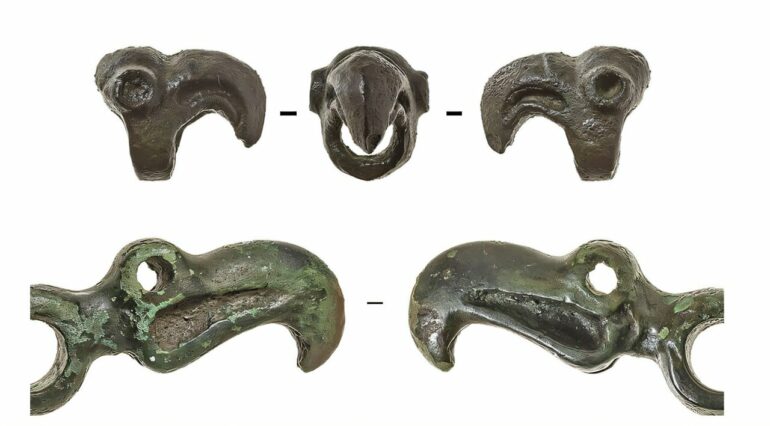
The entire corpus of the Tunnug 1 Scythian animal style is represented by only four animal motifs, namely ovicaprids (e.g., rams), felines, birds, and snakes.
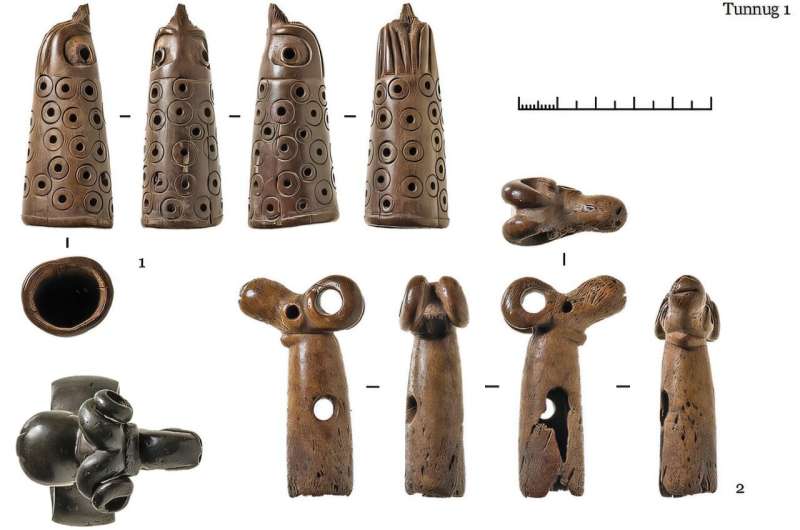
Ovicaprid artifacts labeled 1 to 3. 1) bone finial from a burial in a coffin; 2) bone finial from a mixed context in a wooden chamber; 3) bronze finial from cluster 4. © Sadykov et al. 2025
Elaborating on this, Dr. Caspari says, “The steppe of the first millennium BCE has to be considered prehistoric, meaning we do not have any local written sources that would allow us to go into much detail with regard to symbolic interpretations.
“Clearly, wild animals were very important as spirits inhabiting the natural world, and it’s really interesting that we mostly see depictions of wild animals and barely any domesticated animals (the rams are probably wild argali sheep).”
This limited repertoire stands in stark contrast to the elaborate menagerie of creatures that would later dominate Scythian art. Additionally, the majority of these animal-style artifacts were associated with horses, including cheekpieces, harness appliques, and strap distributors, with only two examples, both depicting felines, associated with daggers.

Discover the latest in science, tech, and space with over 100,000 subscribers who rely on Phys.org for daily insights.
Sign up for our free newsletter and get updates on breakthroughs,
innovations, and research that matter—daily or weekly.
Similarly, animal-style artifacts, which were later also often found in association with gold, were here mainly produced from bone and bronze. While gold was found at two undisturbed burials in Tunnug 1, neither of them utilized this metal for the creation of Scythian animal-style artifacts.
The study hypothesizes that the diversity of motifs and applications of Scythian animal-style artifacts likely emerged as a consequence of different social groups with different artistic and technological traditions coming together in the Uyuk Valley of the Kings to conduct funerary rituals.
At present, the researchers are carefully working on analyzing the remaining finds from this unique site in the hope of gaining further insights into this enigmatic period in the Scythian world.
“At the moment, we are mostly working with data we’ve already