The Mongolian collection of the Ethnological Museum of the National Museums in Berlin contains a unique Gungervaa shrine. Among the objects found inside were three tiny scrolls, wrapped in silk. Using 3D X-ray tomography, a team at HZB was able to create a digital copy of one of the scrolls. With a mathematical method, the scroll could be virtually unrolled to reveal the scripture on the strip. This method is also used in battery research. The paper is published in the Journal of Cultural Heritage.
Buddhism in Mongolia has developed its own traditions that are linked to nomadic culture. Many families had a small portable shrine that they took with them wherever they went. As well as statues, images and decorative objects, these shrines sometimes contained relics and small, tightly rolled scrolls inscribed with prayers, known as “dharanis.” During the revolutionary period from 1921 to 1930, this cultural practice was almost completely eradicated with many shrines being destroyed.
However, one of these shrines ended up in Germany, where it was stored in the Ethnological Museum’s archives. Little was known about its origins. When Birgit Kantzenbach, a restorer at the Ethnological Museum, began researching the shrine a few years ago, she found that nothing was in its place; fabric flowers, relics, small statues and three small scrolls lay in a jumble. She first traveled to Mongolia.
“An object always means only what people see in it; that’s what’s important,” she says. She then turned to HZB physicist Tobias Arlt to examine the small scrolls wrapped in silk.
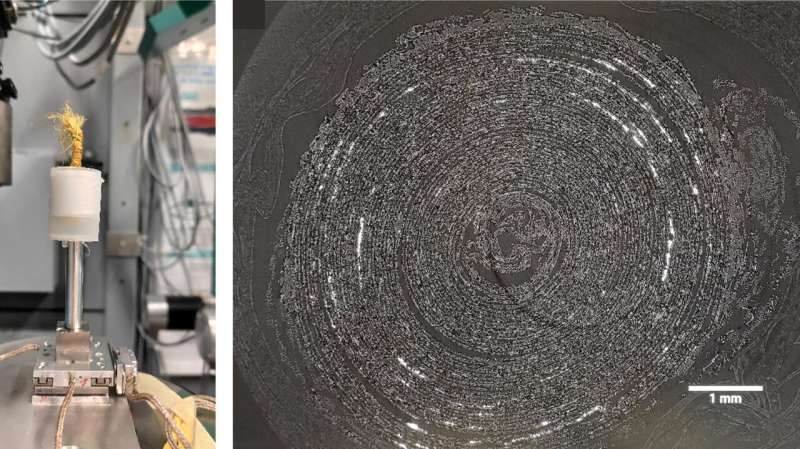
The image on the left shows the scroll at the BAMline at BESSY II. On the right is a reconstructed cross-section of the scroll. Traces of metal containing ink appear light in color, while the paper is gray and the air is dark. © DOI: 10.1016/j.culher.2025.06.009
Non destructive investigation at BESSY II
Until a few years ago, such scrolls would simply have been unwrapped and unrolled to check for inscriptions However, this carries the risk of damaging the material and causing irreversible changes. Tobias Arlt examined the Dharani scrolls at the tomography station of the Federal Institute for Materials Research and Testing (BAM) at BESSY II.
“The high-resolution 3D images show that there are around 50 windings in each scroll, with strips measuring over 80 centimeters that are wound tightly and carefully,” says Arlt.
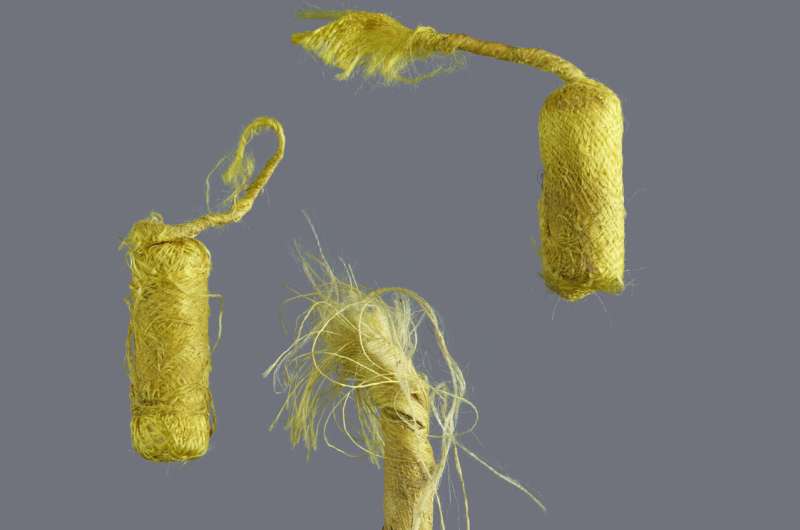
Three tiny scrolls between 3 and 5 centimeters long were found inside the shrine. They are wrapped in silk and glued together. © Staatliche Museen zu Berlin, Ethnologisches Museum / Martin Franken
Virtual unrolling
Using a mathematical method developed at the Konrad Zuse Institute and the corresponding Amira software, he was able to virtually unroll the strip from the 3D data of the rolled sample. Originally, this process took a long time to complete, but with the help of artificial intelligence, it is now considerably faster.
“We are continuing to optimize this complex process of virtual unrolling,” says Arlt. “We also use this method in our own research, for example to analyze changes in tightly wound or folded batteries.”
Mantra of universal compassion
In fact, traces of ink were visible on the virtually unrolled strips. “This is interesting because Chinese ink traditionally consists of a mixture of soot and animal glue, but in this case, ink containing metal particles was apparently used,” says Kantzenbach. The characters are Tibetan, but the language is Sanskrit, a combination that came as a surprise. The well-known Tibetan Buddhist mantra for universal compassion appeared: “Om mani padme hum.”

The Mongolian Gungervaa shrine can be admired until 1 June 2026 in the exhibition “Restoration in Dialogue” at the Humboldt Forum in Berlin. Admission to the exhibition at the Humboldt Forum is free. There are plans to display the shrine in Mongolia afterwards.
More information:
T. Arlt et al, Revealing the history of a Mongolian shrine by virtually unrolling Buddhist Dharanis, Journal of Cultural Heritage (2025). DOI: 10.1016/j.culher.2025.06.009
Provided by
Helmholtz Association of German Research Centres
Citation:
Scrolls from Buddhist shrine virtually unrolled with X-ray (2025, July 24)