
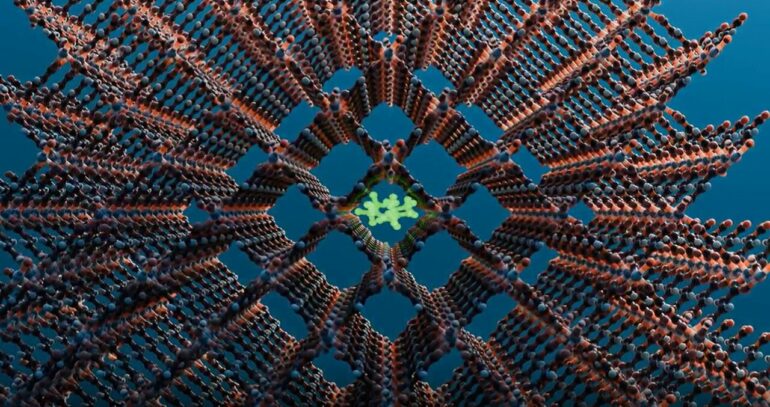
When the 2025 Nobel Prize in Chemistry honored Omar Yaghi – the “father of metal-organic frameworks,” or MOFs – along with Susumu Kitagawa and Richard Robson, it celebrated more than the creation of a new class of crystalline materials. It recognized a revolution quietly reshaping how scientists capture, store and sense molecules. These MOFs could allow for sensor technologies that make workplaces, the environment and human bodies safer.
What are MOFs, and why do they matter?
MOFs are made by linking metal ions – atoms that carry an electrical charge – with organic molecules, the carbon-based building blocks found in most living things. Together they form tiny, sponge-like structures full of microscopic pores. You can imagine them as an atomic-scale scaffold filled with nano-sized rooms, each precisely engineered to host certain molecules like guests.
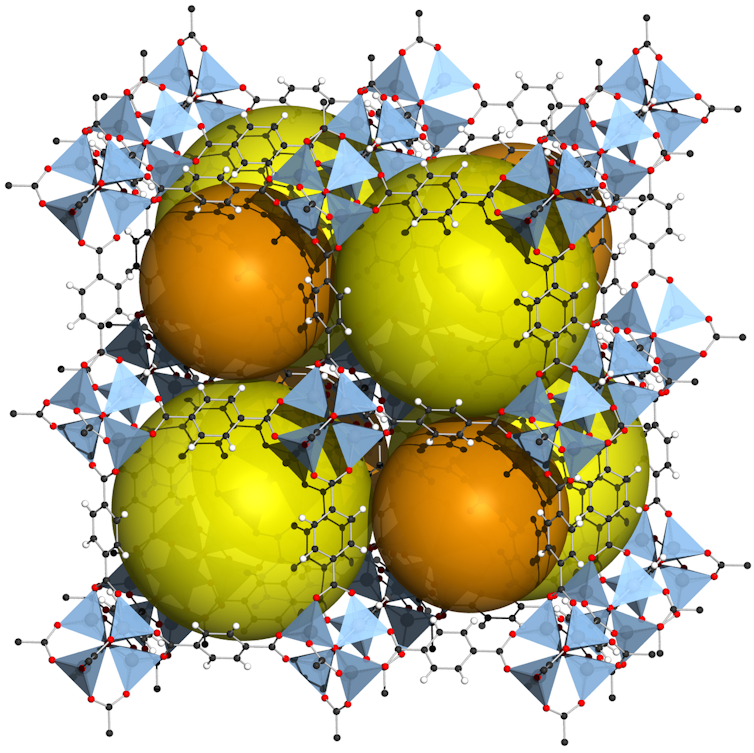
Metal-organic frameworks, such as MOF-5 shown here, have metal components, organic ‘linkers’ and a cavity that can allow in gases.
Tony Boehle/Wikimedia Commons, CC BY-SA
Because chemists can mix and match different metals and organic linkers, there are thousands of possible MOFs – each with unique properties. Depending on how they’re structured, some have so much internal surface area that a single gram could cover a football field.
This sponge-like porosity – meaning lots of tiny holes inside – lets MOFs trap and release gases, store energy-rich fuels like hydrogen, and capture harmful pollutants. MOFs can use a variety of chemicals in their structure, which lets researchers fine-tune how strongly an MOF interacts with specific molecules.
These features have already inspired potential uses such as capturing carbon dioxide from the air to reduce greenhouse gas concentrations in the atmosphere, pulling clean water from humid air, and delivering medicines inside the body. Over the past decade, the unique properties of MOFs have also opened new possibilities for sensing and detection.
Since 2016, our team of engineers has been developing MOF-based sensors that can detect certain gases and vapors in an environment in real time. These materials’ unique properties are opening new possibilities for sensing in health, safety and environmental monitoring.

From a storage material to a sensing material
When an MOF takes in gas or liquid molecules, its tiny framework changes ever so slightly: It may change in size, how it bends light, or how it conducts electricity, depending on what and how many molecules it absorbs.
By connecting MOFs to devices that can sense changes in light or electricity, researchers can turn these tiny shifts into measurable signals such as light, frequency or voltage. The signals then reveal what chemical is present and how much of it there is. In simple terms, when molecules enter or leave the MOF’s pores, they slightly change how light travels through it or how electricity behaves around it, and…