
Curious Kids is a series for children of all ages. If you have a question you’d like an expert to answer, send it to [email protected].
Can we generate a way to interact with dark matter with current technology? – Leonardo S., age 13, Guanajuato, Mexico
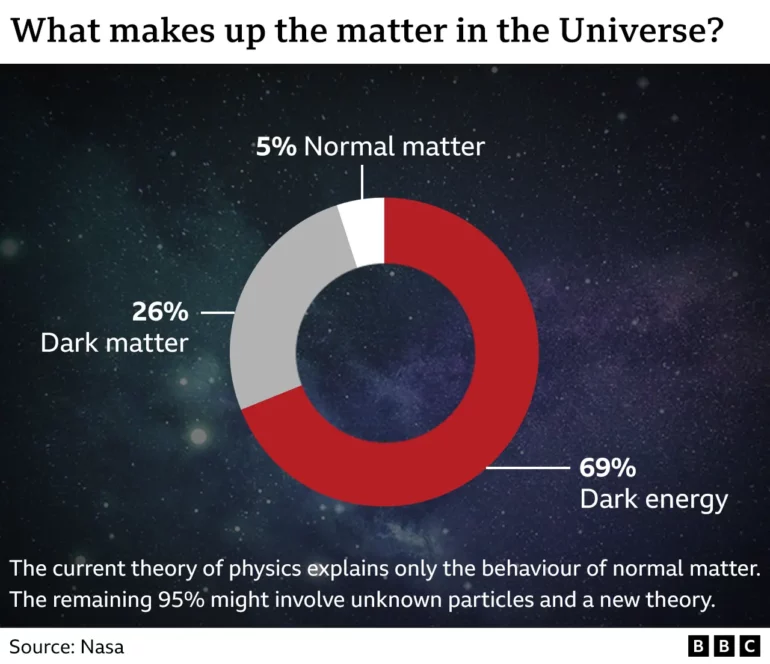
That’s a great question. It’s one of the most difficult and fascinating problems right now in both astronomy and physics, because while scientists know that the elusive substance called dark matter makes up the majority of all matter in the universe, we’ve never actually observed it directly. Dark matter is so difficult to interact with because it’s “dark,” which means it doesn’t interact directly with light in any way.
I’m a physicist, and scientists like me observe the world around us mainly by looking for signals from different wavelengths of light. So no matter what type of technology scientists use, they run into the same issue in the hunt for dark matter.
It’s not completely impossible to interact with dark matter, though, because it can interact with ordinary matter in other ways that don’t involve light. But those interactions are generally very weak. What we call dark matter is really anything that we can see only through these weaker interactions, especially gravity.
How we know dark matter exists
One way that dark matter can interact with ordinary matter is through gravity. In fact, gravity is the main reason scientists even think dark matter exists at all.
For decades, scientists have been observing how galaxies spin and move throughout the universe. Gravity acts on stars and galaxies, in the same way it keeps you from floating off into space. Heavier objects have a stronger gravitational pull. At these huge scales, researchers have spotted some unexpected quirks that gravity alone can’t explain.
For example, almost 100 years ago, a Swiss astronomer named Fritz Zwicky studied a cluster of galaxies called the Coma Cluster. He noticed the galaxies inside it were moving very fast, so much so that they should have flown apart many millions of years ago.

The only way the cluster could have stayed together for so long is if there was much more matter holding it together with gravity than the telescope could see. This extra matter necessary to hold the galaxies together became known as dark matter.
About 40 years after Zwicky, an American astronomer named Vera Rubin looked at the individual stars moving around the centers of spiral galaxies as they rotated. She saw that the stars at the outside edges of the spiral were moving much faster than you’d expect if only the gravity from the stars you could see was keeping them from flying off into intergalactic space.
Just as with the galaxies moving around the cluster, the motion of the stars around the edges of the galaxies could be best explained if there was much more matter in the galaxies than what we could see.