The adage goes “like mother like daughter,” and in the case of Irene Joliot-Curie, truer words were never spoken. She was the daughter of two Nobel Prize laureates, Marie Curie and Pierre Curie, and was herself awarded the Nobel Prize in chemistry in 1935 together with her husband, Frederic Joliot.
While her parents received the prize for the discovery of natural radioactivity, Irene’s prize was for the synthesis of artificial radioactivity. This discovery changed many fields of science and many aspects of our everyday lives. Artificial radioactivity is used today in medicine, agriculture, energy production, food sterilization, industrial quality control and more.
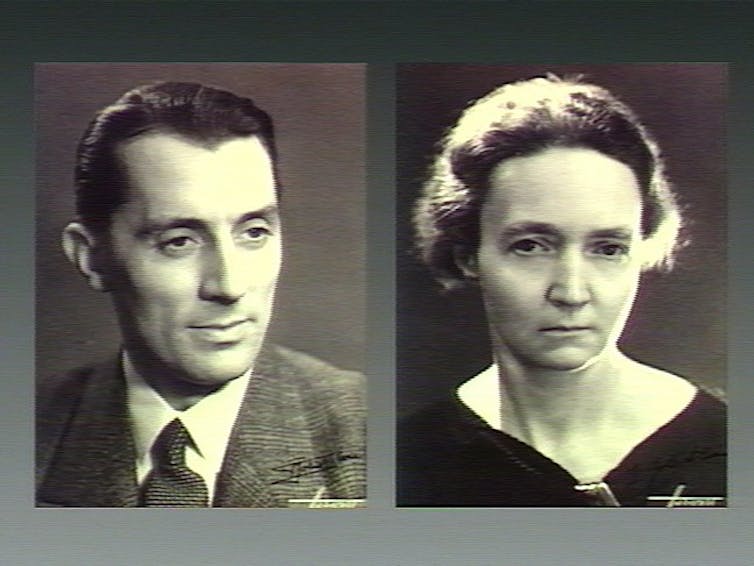
Frederic Joliot and Irene Joliot-Curie.
Wellcome Collection, CC BY
We are two nuclear physicists who perform experiments at different accelerator facilities around the world. Irene’s discovery laid the foundation for our experimental studies, which use artificial radioactivity to understand questions related to astrophysics, energy, medicine and more.
Early years and battlefield training
Irene Curie was born in Paris, France, in 1897. In an unusual schooling setup, Irene was one of a group of children taught by their academic parents, including her own by then famous mother, Marie Curie.
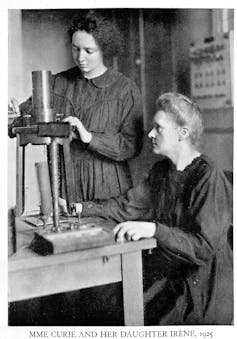
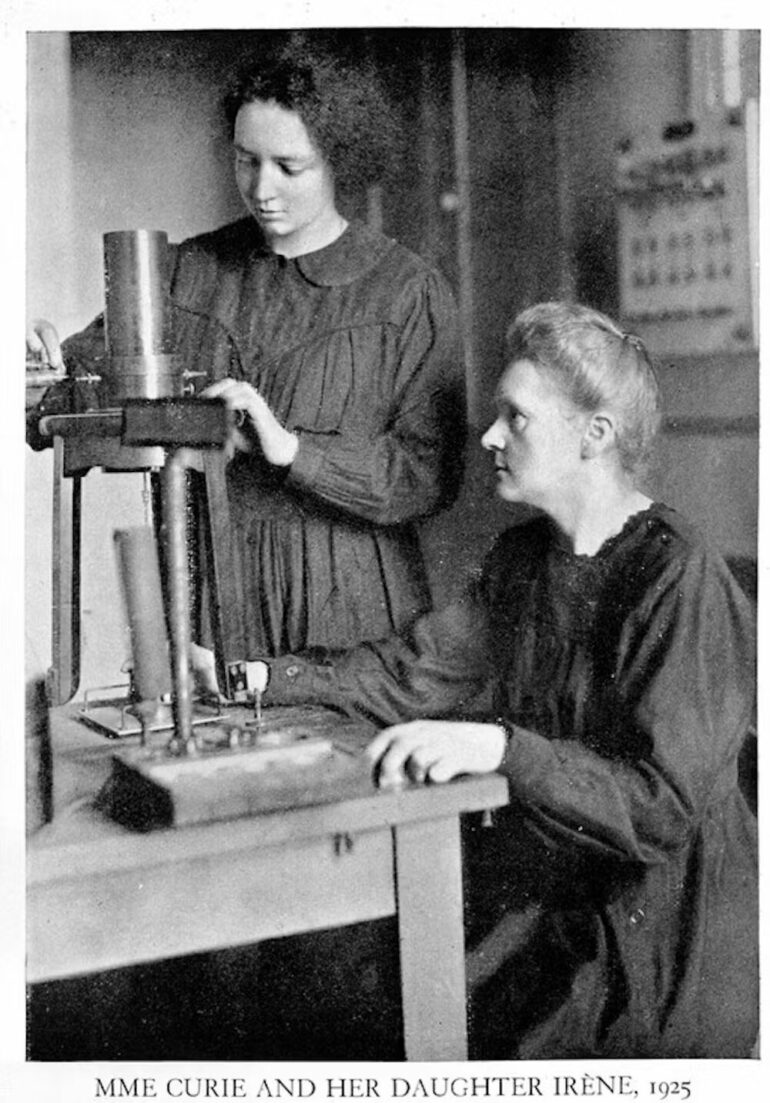
Marie Curie and her daughter Irene were both scientists studying radioactivity.
Wellcome Collection, CC BY
World War I started in 1914, when Irene was only 17, and she interrupted her studies to help her mother find fragments of bombs in wounded soldiers using portable X-ray machines. She soon became an expert in these wartime radiology techniques, and on top of performing the measurements herself, she also spent time training nurses to use the X-ray machines.
After the war, Irene went back to her studies in her mother’s lab at the Radium Institute. This is where she met fellow researcher Frederic Joliot, whom she later married. The two worked together on many projects, which led them to their major breakthrough in 1934.
A radioactive discovery
Isotopes are variations of a particular element that have the same number of protons – positively charged particles – and different numbers of neutrons, which are particles with no charge. While some isotopes are stable, the majority are radioactive and called radioisotopes. These radioisotopes spontaneously transform into different elements and release radiation – energetic particles or light – in a process called radioactive decay.
At the time of Irene and Frederic’s discovery, the only known radioactive isotopes came from natural ores, through a costly and extremely time-consuming process. Marie and Pierre Curie had spent years studying the natural radioactivity in tons of uranium ores.
In Irene and Frederic’s experiments, they bombarded aluminum samples with alpha particles, which consist of two protons and two neutrons bound together…