
Quantum mechanics describes the weird behavior of microscopic particles. Using quantum systems to perform computation promises to allow researchers to solve problems in areas from chemistry to cryptography that have so many possible solutions that they are beyond the capabilities of even the most powerful nonquantum computers possible.
Quantum computing depends on researchers developing practical quantum technologies. Superconducting electrical circuits are a promising technology, but not so long ago it was unclear whether they even showed quantum behavior. The 2025 Nobel Prize in physics was awarded to three scientists for their work demonstrating that quantum effects persist even in large electrical circuits, which has enabled the development of practical quantum technologies.
I’m a physicist who studies superconducting circuits for quantum computing and other uses. The work in my field stems from the groundbreaking research the Nobel laureates conducted.
Big, cold, quantum
In their 1984 and 1985 work, then-Ph.D. student John Martinis, then-postdoctoral researcher Michel Devoret and UC Berkeley professor John Clarke showed that even large electrical circuits could exhibit quantum behavior. They used a circuit made from niobium and lead. When cooled to a few degrees above absolute zero, these metals become superconductors. A superconductor is a material that carries a current without generating any heat.
Martinis, Devoret and Clarke showed that in a superconductor, the voltages and currents are governed by quantum mechanics. The circuit has quantized – meaning discrete and indivisible – levels of energy, and it can be in superpositions of multiple states.
Any physical system can be described by a state, which tells you everything there is to know about that system. Quantum mechanics shows that a state can have certain quantized values of things that can be measured. An example is energy: A particular system could have energy 1 or energy 2, but nothing in between. At the same time, a quantum system can be in a superposition of more than one state, much like you can add different amounts of red/green/blue to get any color in a pixel of an image.
Importantly, the laureates showed that researchers can describe one of these superconducting circuits as if it’s a single quantum particle. This simple behavior is what makes superconducting circuits so useful as a technology.
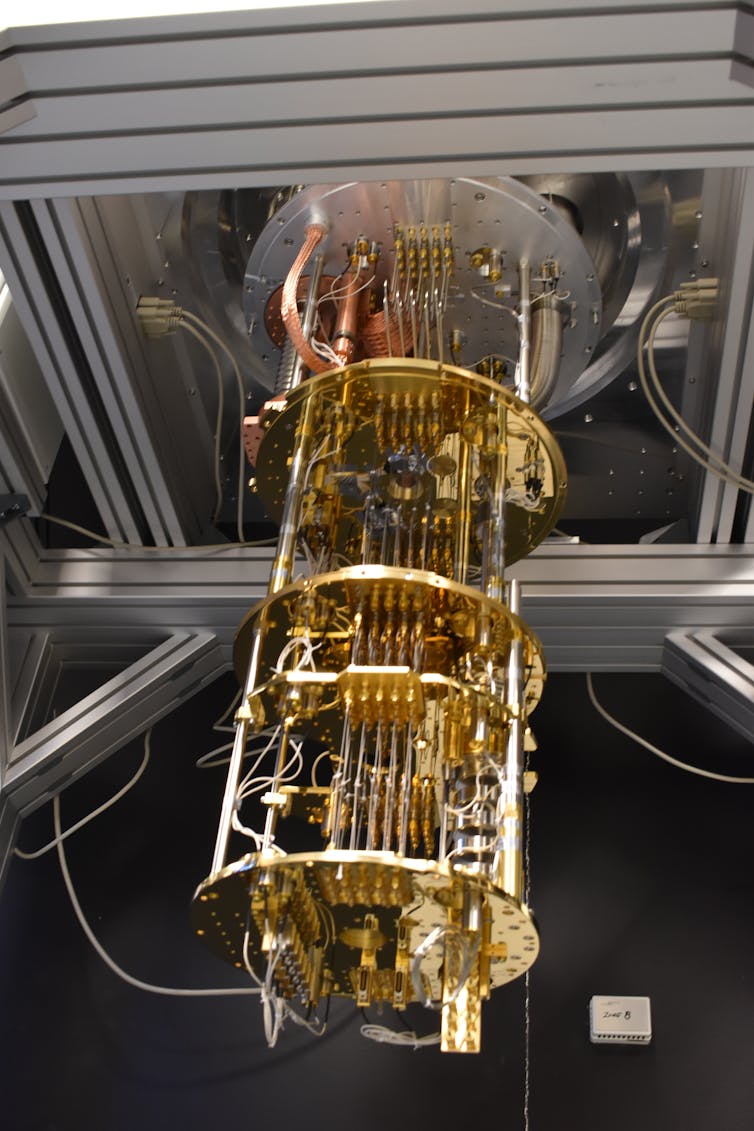

Dilution refrigerators like this chill their contents to near-absolute zero.
U.S. Air Force Research Laboratory
Today, superconducting circuits are used to study fundamental quantum physics, to simulate other physical systems and to test protocols for ultraprecise sensing. For instance, the Devoret group recently demonstrated a near-ideal microwave amplifier based on a superconducting circuit. Microwave amplifiers are widely used in communications, radar and scientific instruments.
The Martinis group has used…