
Curious Kids is a series for children of all ages. If you have a question you’d like an expert to answer, send it to [email protected].
“Is the Moon getting farther away from Earth?” – Judah, 9, Broken Arrow, Oklahoma
The Moon is getting 1½ inches (3.8 centimeters) farther away from the Earth every year.
Scientists measure the distance to the Moon by bouncing lasers off mirrors placed there by space probes and astronauts.
By measuring the amount of time it takes light to travel to the Moon and back, scientists can very precisely measure the distance to the Moon and how the distance changes.
The distance to the Moon actually changes over a single month as it goes around the Earth. The Moon is typically 239,000 miles (385,000 km) away from the Earth, but its orbit is not a perfect circle and changes by about 12,400 miles (20,000 km) as it orbits the Earth. This change is why some full moons are a bit bigger than others; these are called supermoons.
As an astrophysics researcher, I’m interested in the motion and interaction of objects such as planets, stars and galaxies. The motions of the Earth and Moon have many interesting consequences, and studying how they move over time can help researchers better understand how each has changed over the 4½ billion years since the Earth and Moon formed.
Tidal forces
So, why is the Moon getting farther away? It’s all because of tides.
Tides come from a difference in gravity across an object. The force of gravity exerted by the Moon is about 4% stronger on the side of Earth that faces toward the Moon, compared to the opposite side of the Earth facing away, because gravity gets weaker with distance.
This tidal force causes the oceans to slosh around in two bulges that point toward and away from the Moon. They do this because the gravitational force pulling on Earth by the Moon isn’t just an average force that’s the same strength everywhere. The Moon’s gravity is strongest on the closer side of the Earth, creating a bulge of water pointing toward the Moon. It’s weaker on the opposite side of the Earth, which leaves another bulge of water that lags behind the rest of the Earth.
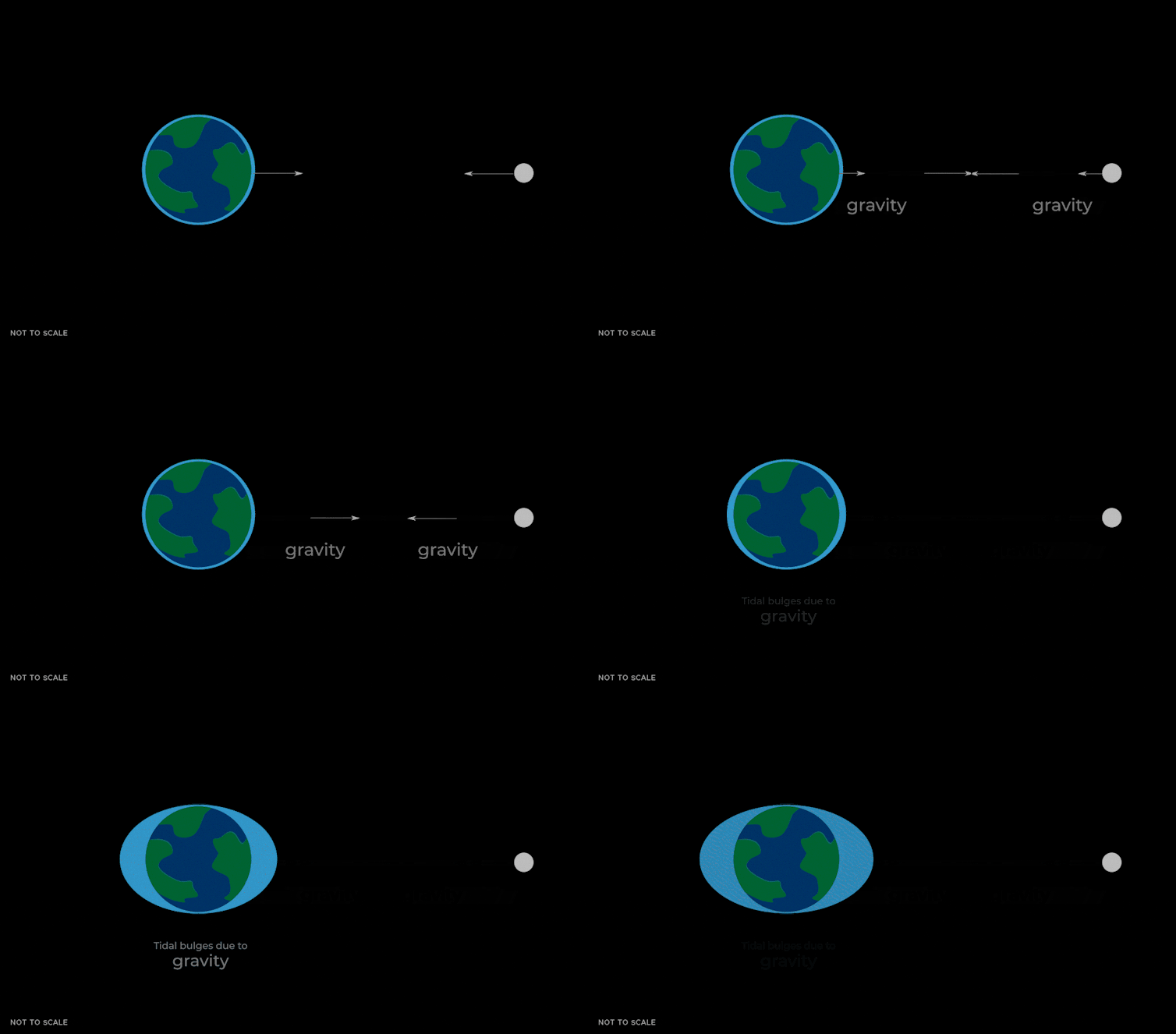
A NASA animation, not to scale, shows how the Moon creates tides on the Earth. The water in the oceans sloshes toward and away from the Moon.
NASA/Vi Nguyen
As the Earth rotates, these bulges move around and keep pointing at the Moon because of its gravitational pull. In New York City or Los Angeles, the water level can change by about 5 feet due to these tidal bulges.
These liquid bulges do not quite line up with the Moon – they “lead” it a little bit because the Earth is rotating and dragging them forward. These bulges also exert a gravitational pull back on the Moon. The bulge closer to the Moon isn’t just pulling the Moon toward the center of the Earth, but also a little bit ahead in its…