
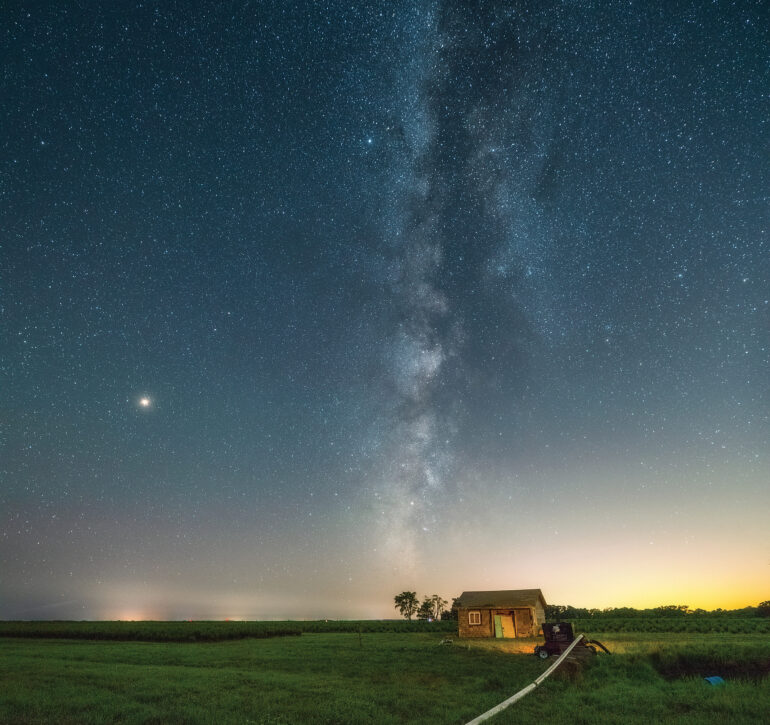
The night sky has long sparked wonder and curiosity. Early civilizations studied the stars and tracked celestial events, predicted eclipses and used their observations to construct calendars, develop maps and formulate religious rituals.
Scholars widely agree that astronomy is a gateway science – that it inspires a core human interest in science among people of all ages, from senior citizens to schoolchildren. Helping young people tap into their excitement about the night sky helps them build confidence and opens career pathways they may not have considered before.
Yet today the night sky is often hidden from view. Almost all Americans live under light-polluted skies, and only 1 in 5 people in North America can see the Milky Way. When people live in areas where the night sky is clearer, they tend to express a greater wonder about the universe. Altogether, this means communities with less light pollution have great potential to educate the next generation of scientists.
Rural communities have some of the darkest skies in the country, making them perfect for stargazing. Yet while students in rural areas are in the optimal physical environment to be inspired by the night sky, they are the most in need of science, technology, engineering and mathematics, or STEM, education resources to support their interests and build the confidence they need to pursue careers in science.
Stargazing, finding constellations and watching meteor showers as a kid inspired my own sense of awe around the vastness of space and possibilities in our universe. Now, I’m the executive director of the Smithsonian’s Scientists Taking Astronomy to Rural Schools, or STARS, a new program led by the Smithsonian Astrophysical Observatory, part of the Center for Astrophysics | Harvard & Smithsonian, that delivers telescopes and associated lesson plans to rural schools across the United States, free of charge. I’m working to share my excitement and wonder with students in rural areas.

A solar eclipse, as viewed through a telescope.
STARS
Why hands-on STEM learning matters
Students need direct exposure to STEM careers and hands-on experiences that help them learn the skills they will need to pursue these careers on their own. Hands-on activities ground new knowledge in ways that lectures and reading often cannot. Experiential opportunities connect what may be distant or abstract concepts to clear, tangible, real-world skills. This experiential learning improves students’ understanding of astronomy content and increases their motivation to learn.
Telescopes are important tools for astronomy that scientists use all the time. When students use telescopes as part of their learning, they are experiencing real techniques that scientists use. Using a telescope brings the viewer closer to fantastic celestial objects – allowing them to see galaxies, nebulas, planets, the Moon and the Sun, with solar filter protection, more…

