
Over the past 400 years or so, a set of mostly unwritten guidelines has evolved for how science should be properly done. The assumption in the research community is that science advances most effectively when scientists conduct themselves in certain ways.
The first person to write down these attitudes and behaviors was Robert Merton, in 1942. The founder of the sociology of science laid out what he called the “ethos of science,” a set of “values and norms which is held to be binding on the man of science.” (Yes, it’s sexist wording. Yes, it was the 1940s.) These now are referred to as scientific norms.
The point of these norms is that scientists should behave in ways that improve the collective advancement of knowledge. If you’re a cynic, you might be rolling your eyes at such a Pollyannaish ideal. But corny expectations keep the world functioning. Think: Be kind, clean up your mess, return the shopping cart to the cart corral.
I’m a physical geographer who realized long ago that students are taught biology in biology classes and chemistry in chemistry classes, but rarely are they taught about the overarching concepts of science itself. So I wrote a book called “The Scientific Endeavor,” laying out what scientists and other educated people should know about science itself.
Scientists in training are expected to learn the big picture of science after years of observing their mentors, but that doesn’t always happen. And understanding what drives scientists can help nonscientists better understand research findings. These scientific norms are a big part of the scientific endeavor. Here are Merton’s original four, along with a couple I think are worth adding to the list:
Universalism
Scientific knowledge is for everyone – it’s universal – and not the domain of an individual or group. In other words, a scientific claim must be judged on its merits, not the person making it. Characteristics like a scientist’s nationality, gender or favorite sports team should not affect how their work is judged.
Also, the past record of a scientist shouldn’t influence how you judge whatever claim they’re currently making. For instance, Nobel Prize-winning chemist Linus Pauling was not able to convince most scientists that large doses of vitamin C are medically beneficial; his evidence didn’t sufficiently support his claim.
In practice, it’s hard to judge contradictory claims fairly when they come from a “big name” in the field versus an unknown researcher without a reputation. It is, however, easy to point out such breaches of universalism when others let scientific fame sway their opinion one way or another about new work.

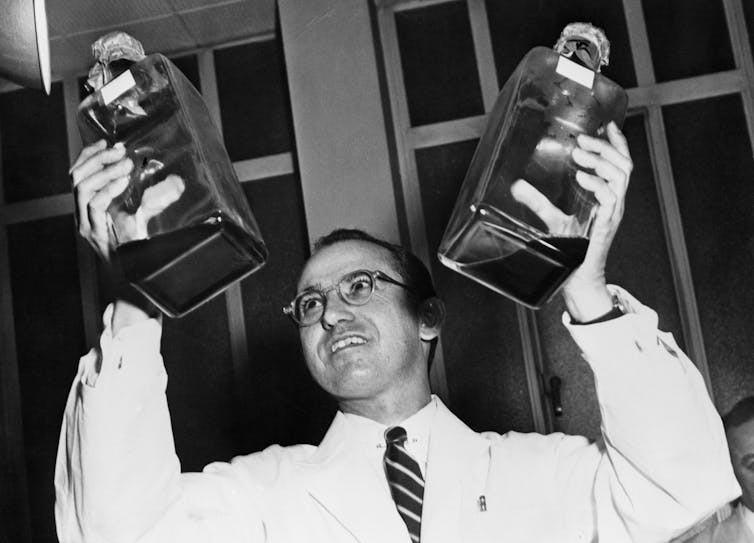
When asked about patenting his polio vaccine, Jonas Salk replied, ‘There is no patent. Could you patent the sun?’
Bettmann via Getty Images
Communism
Communism in science is the idea that scientific knowledge is the property of everyone and must…