The earliest form of the signature came from ancient Iraq in the form of cylinder seals.
Mesopotamians, the ancient inhabitants of the land between the Euphrates and Tigris rivers, are credited for many firsts in human history, including writing, urbanism and the state. Among these inventions, cylinder seals are perhaps the most distinctive but least known.
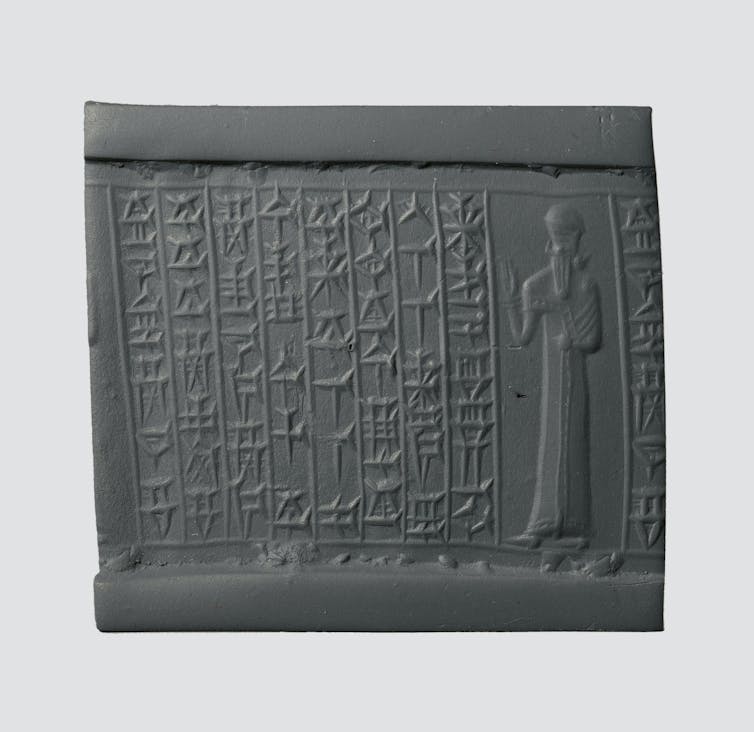
Babylonian seal made of chalcedony, circa 14th century B.C.E., inscribed with a hymn to the goddess Inanna. The seal was owned by a man named Tunamisah, son of Pari.
Gift of The Right Reverend Paul Moore Jr., 1985/Metropolitan Museum of Art
Seals as artifacts
Thousands of these tiny objects – often no bigger than 2 inches (5 centimeters) in height and 1 inch (2.5 cm) in diameter – are displayed in museums today. They testify to an artistic tradition in ancient Iraq and Syria that remained uninterrupted from the late fourth to first millennia B.C.E.
In essence, a cylinder seal was a small sculpture that served a crucial utilitarian purpose: signing documents. It was generally made of a precious or semiprecious stone such as lapis lazuli, agate or chalcedony. Images and texts were engraved into the stone with a technique called intaglio. Notably, these engravings would need to be made in reverse of how the markings would look when it was used.
When rolled on a moist clay tablet, these engravings left low-relief markings, signifying that the object’s owner authorized the written document. In this respect, a cylinder seal’s impression is the ancestor of modern handwritten and digital signatures.
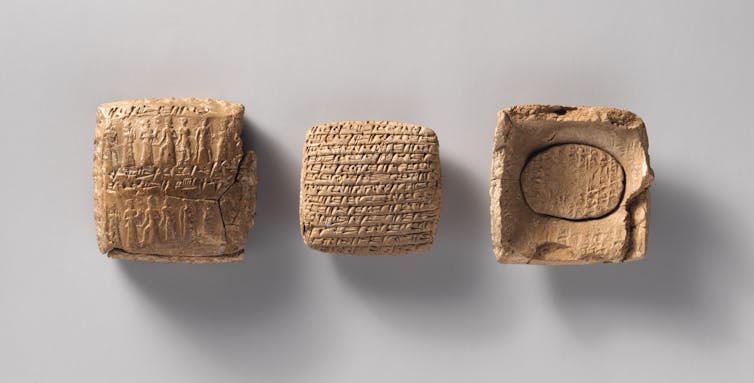
Clay envelope and tablets from Kültepe-Kanesh (now Turkey), circa 20th-19th centuries BCE. The writer, Ashur-muttabbil, impressed – or signed – the envelope twice with a cylinder seal.
Bequest of Edith Aggiman, 1982/Metropolitan Museum of Art
Seals and identity
While cylinder seals were a creation of the Sumerians who inhabited southern Mesopotamia about 6,000 years ago, they rapidly spread to the rest of Western Asia and the eastern Mediterranean and became important items in everyday life.

Communities in this vast region – especially those in Mesopotamia, an area poor in raw materials – imported stones from distant lands to make their seals. Mesopotamians extracted diorite from Oman, lapis lazuli from Afghanistan, and carnelian and agate from the Indus Valley and other parts of South Asia.
Seals made of these exotic stones were extra valuable, so only the elite could afford them. Often affiliated with the state and temples, these people were typically royalty, high-level bureaucrats and priests. In contrast, people from lower classes used seals made of less valuable materials, such as limestone, clay or glass.
Mesopotamians and their contemporaries in Western Asia expressed their identities not just through the material of their seals but also through the texts and images engraved on…