
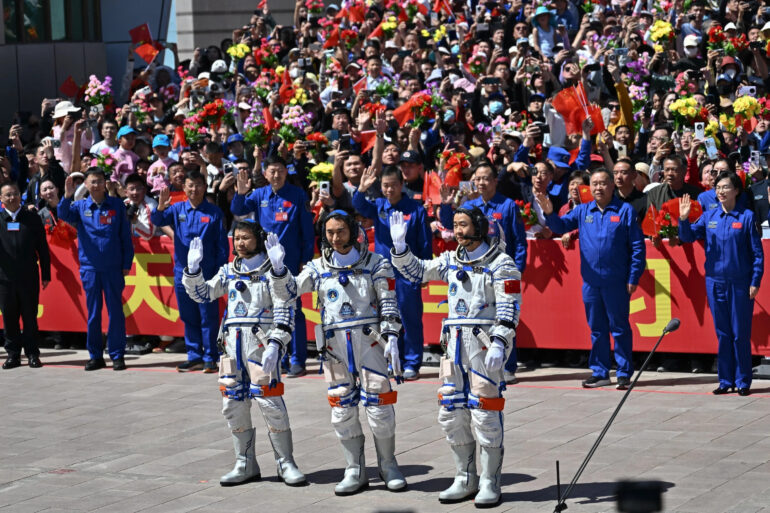
China’s Shenzhou-20 spacecraft took a hit from a piece of space debris floating through orbit, causing Chinese officials to delay the spacecraft’s return from its Tiangong space station in early November 2025.
In addition to stranding the three Chinese astronauts – called taikonauts – who were set to return to Earth, this incident highlights the increasing risks posed to China and the broader international community by the growing amount of space debris.
I study China’s space program. My research suggests that national pride plays an important role in China’s growing space ambitions. As China continues to invest in expensive space capabilities, it will also likely become increasingly sensitive to losing them. The rise in space debris may create incentives for Chinese officials to cooperate with the United States on measures that reduce the risk of collisions.
Space debris – a growing issue
Space debris is creating growing problems for space operations. It includes any artificial objects in orbit not operating as satellites or spacecraft. It ranges in size from a fleck of paint to large rocket bodies roughly the size of a school bus.
In the most commonly used orbit – low Earth orbit – this debris can move at speeds of roughly 18,000 mph, almost seven times the speed of a bullet. At such high speeds, even tiny pieces of space debris can be highly destructive, to the point that this debris might continue to multiply until one day it makes certain critical orbits unusable. When space debris collides with other objects and fragments, they can break into smaller pieces, generating even more debris.
It’s somewhat ironic that China’s spacecraft took a hit from space junk. The country is responsible for creating the majority of space debris. In 2007, China blew up a defunct Fengyun-1c weather satellite to test an anti-satellite weapon. It generated the most space debris in history – over 3,000 pieces are still orbiting today.
This short clip shows the increase in space debris in orbit around Earth.
On several occasions, the International Space Station has had to maneuver to narrowly avoid being struck by debris from this test, including as recently as 2021.

Anti-satellite weapons
Why would China, or any other country, want to develop an anti-satellite weapon? Satellites provide significant benefits to militaries. They help with reconnaissance and intelligence, allow for the precise targeting and guidance of long-range munitions, support communication over large distances and supply weather data, to name just a few uses.
These advantages were showcased during the first Gulf War, often called the “first space war.” The United States used space technologies to quickly and decisively defeat the Iraqi military within weeks, and with far fewer casualties than expected. The Gulf War had a profound impact on Chinese military thinking, with…

