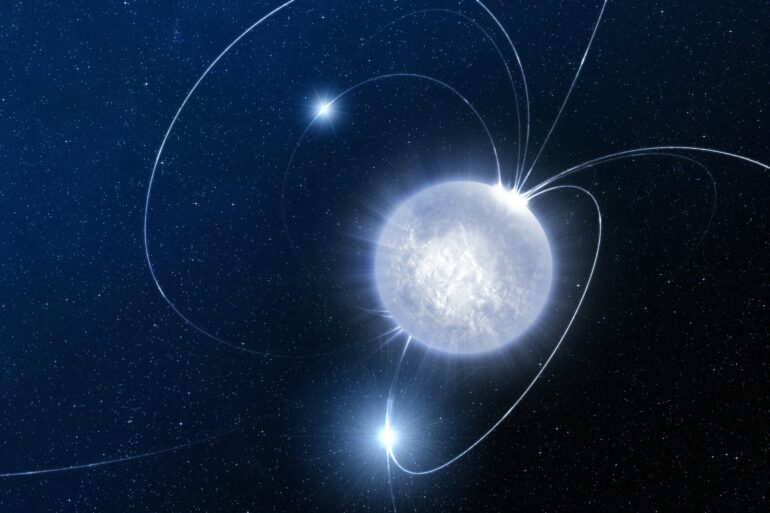
Billions of light years away in a remote part of the universe, two neutron stars – the ultradense remnants of dead stars – collided. The catastropic cosmic event sent light and particles, including a sudden flash of gamma rays, streaming through the universe. These gamma rays traveled for 8.5 billion years before reaching Earth.
In a new study, our team of astrophysicists examined this gamma-ray signal. We learned that the stellar collision it came from was likely caused by an even more catastrophic encounter – a merger between two galaxies.

An illustration shows a galaxy merger, an event that leads to star collisions and the creation of valuable metals.
Fortuna, Dichiara/ERC BHianca 2026, CC BY-NC-SA 4.0, CC BY-SA
This is the first time astronomers associated this type of signal with such a large-scale galactic interaction. Our finding offers new insight into how stellar collisions spread metals across the universe.
Why it matters
When two neutron stars orbit each other and finally collide – a system called a binary neutron star merger – they produce the most powerful explosions in the universe. They release intense flashes of gamma rays, which astronomers call short gamma-ray bursts. They can release as much energy as our Sun will produce over its entire lifetime in less than a couple of seconds.
In binary neutron star mergers, two dense neutron stars orbit together and eventually collide. In the process, they send out bursts of gamma rays.
These collisions can also eject debris pieces into space, which may create new radioactive elements when they collide. Many valuable elements, including gold and platinum, are forged in these mergers.
What makes the particular event, known as GRB 230906A, extraordinary is where it happened. Using NASA’s Chandra X-ray Observatory and the Hubble Space Telescope, we pinpointed the location of the explosion and identified its host galaxy as one of the faintest galaxies ever associated with a short GRB.
Observations obtained by the Very Large Telescope in Chile revealed that the burst occurred within a tangled system of interacting galaxies. Streams of stars and gas, torn out by past galactic encounters, stretched across the region. The gamma-ray burst lies directly within one of these tidal streams, suggesting it took place inside a tiny dwarf galaxy formed from the material stripped away from its host during a galaxy collision.

The Very Large Telescope in the Atacama Desert in Chile.
ESO/H.H.Heyer, CC BY
This is the first time that a binary neutron star merger has been linked to such an environment. This discovery reveals new homes for these cosmic collisions and shows they don’t just happen in big galaxies. It points to a new path for spreading heavy metals where we least expect them.
Our study traces the origin of these neutron…