
Our two-person team loaded the car with a GPS, a drone, notebooks, sample bags, a trowel and a flat spatula lovingly called a scoopula. Then we drove 30 minutes in our rented truck from Yuma, Arizona, to the Algodones Dunes, a sandy field bordering California, Arizona and Mexico. The day was sunny, with a strong breeze. Turning off the highway, we carefully headed onto a gravelly path that acted as our road.
After making decent – if bumpy – progress, we pulled off onto the sand flats and drove slowly toward the dunes, worried we might get stuck in the sand. Having arrived on the outskirts of the Algodones, we stopped and loaded our backpacks, then set off into the desert on foot.
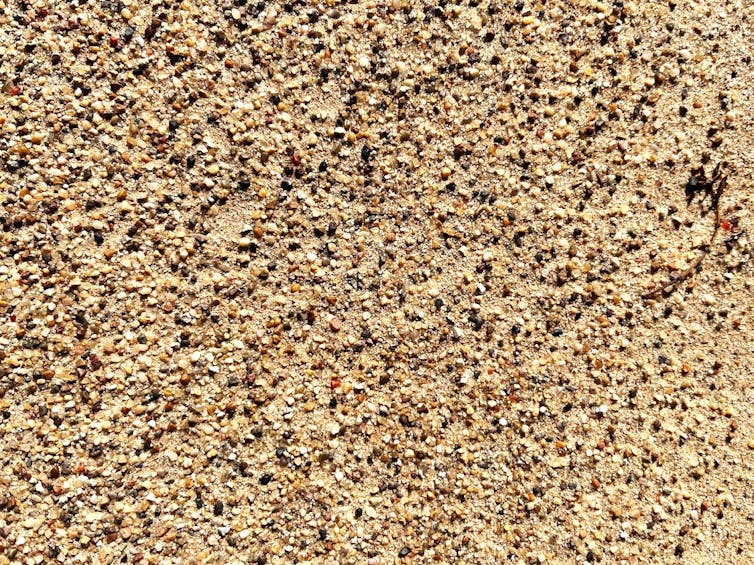
The coarse- and fine-grained sand at the Algodones Dunes.
Lauren Berger
It was November 2022. As a graduate student at Texas A&M University, I was beginning part of my Ph.D. research with my adviser, geology professor Ryan Ewing. We were looking for coarse-grained sand ripples, which are patterned piles of sand shaped by wind. Sand ripples and sand dunes are types of aeolian bedforms, which are wind-created geologic features.
Aeolian bedforms are common on Earth and across the solar system, including on Mars, Venus, Pluto, the Saturn moon Titan, the Neptune moon Triton, and Comet 67P. These geological features, among the first landforms observed by remote images of planetary surfaces, are robust indicators of a world’s wind patterns.
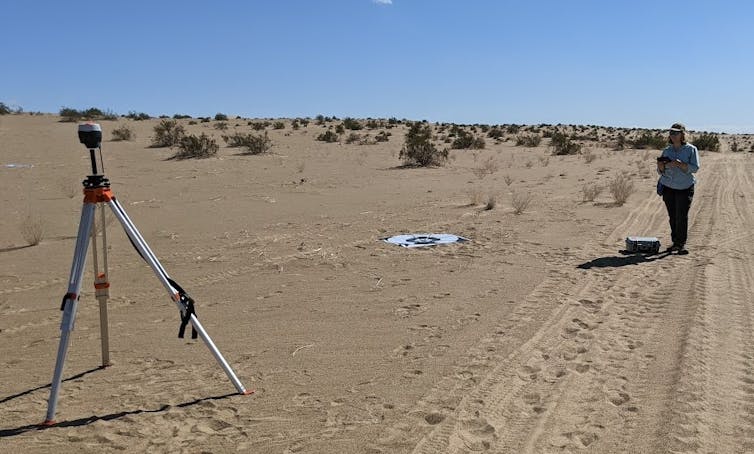
Flying a drone at Algodones. Note the GPS on the tripod, and a GPS target on the ground, which was also a landing pad for the drone.
Ryan Ewing
Measuring sand patterns in person
The shapes and patterns of aeolian bedforms can reveal the environmental conditions that created them.
Two sizes of the same bedform, such as small dunes on top of big dunes, are called compound bedforms. I study compound bedforms at two scales – the meter- and centimeter-sized coarse-grained ripples at the dunes here on Earth, and the kilometer- and meter-sized dunes on Mars.
At the Algodones, I measured the height of each large coarse-grained sand ripple and the distance between neighboring ripples. Then we flew our drone low and steady, above the ripples, to create high-resolution images. The drone data allows us to do further measurements on the ripples later, back at my desk.

On that day, I learned an essential rule of fieldwork in the desert: Don’t forget a shovel. Otherwise, if your vehicle gets stuck, as ours did, you’ll have to dig it out by hand. Luckily for us, a dune buggy driver passing by helped us out and we were able to get back to Yuma in time for dinner.
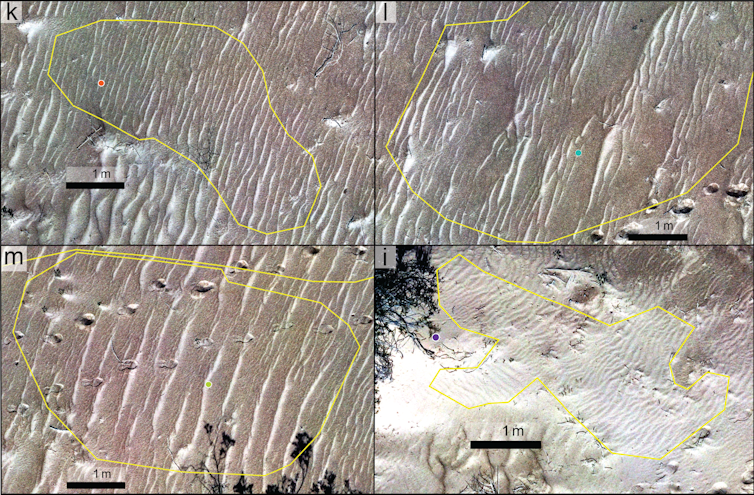
High-resolution drone images of the sand ripples at Algodones.
Lauren Berger
My introduction to Mars
I first became interested in aeolian bedforms during my sophomore year of college, when I interned at the NASA Jet Propulsion Laboratory. My job was to…

