
The Sun will someday die. This will happen when it runs out of hydrogen fuel in its core and can no longer produce energy through nuclear fusion as it does now. The death of the Sun is often thought of as the end of the solar system. But in reality, it may be the beginning of a new phase of life for all the objects living in the solar system.
When stars like the Sun die, they go through a phase of rapid expansion called the Red Giant phase: The radius of the star gets bigger, and its color gets redder. Once the gravity on the star’s surface is no longer strong enough for it to hold on to its outer layers, a large fraction – up to about half – of its mass escapes into space, leaving behind a remnant called a white dwarf.
I am a professor of astronomy at the University of Wisconsin-Madison. In 2020, my colleagues and I discovered the first intact planet orbiting around a white dwarf. Since then, I’ve been fascinated by the prospect of life on planets around these, tiny, dense white dwarfs.
Researchers search for signs of life in the universe by waiting until a planet passes between a star and their telescope’s line of sight. With light from the star illuminating the planet from behind, they can use some simple physics principles to determine the types of molecules present in the planet’s atmosphere.
In 2020, researchers realized they could use this technique for planets orbiting white dwarfs. If such a planet had molecules created by living organisms in its atmosphere, the James Webb Space Telescope would probably be able to spot them when the planet passed in front of its star.
In June 2025, I published a paper answering a question that first started bothering me in 2021: Could an ocean – likely needed to sustain life – even survive on a planet orbiting close to a dead star?
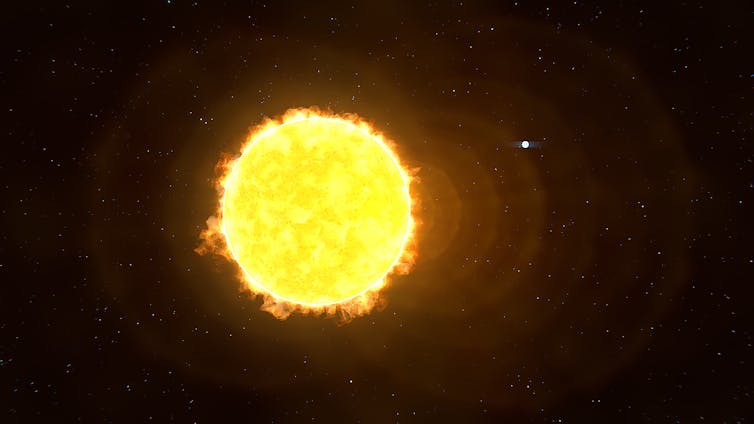
Despite its relatively small size, a white dwarf – shown here as a bright dot to the right of our Sun – is quite dense.
Kevin Gill/Flickr, CC BY
A universe full of white dwarfs
A white dwarf has about half the mass of the Sun, but that mass is compressed into a volume roughly the size of Earth, with its electrons pressed as close together as the laws of physics will allow. The Sun has a radius 109 times the size of Earth’s – this size difference means that an Earth-like planet orbiting a white dwarf could be about the same size as the star itself.

White dwarfs are extremely common: An estimated 10 billion of them exist in our galaxy. And since every low-mass star is destined to eventually become a white dwarf, countless more have yet to form. If it turns out that life can exist on planets orbiting white dwarfs, these stellar remnants could become promising and plentiful targets in the search for life beyond Earth.
But can life even exist on a planet orbiting a white dwarf? Astronomers have known since 2011 that the habitable zone is extremely close to the white dwarf. This zone is the location…

