
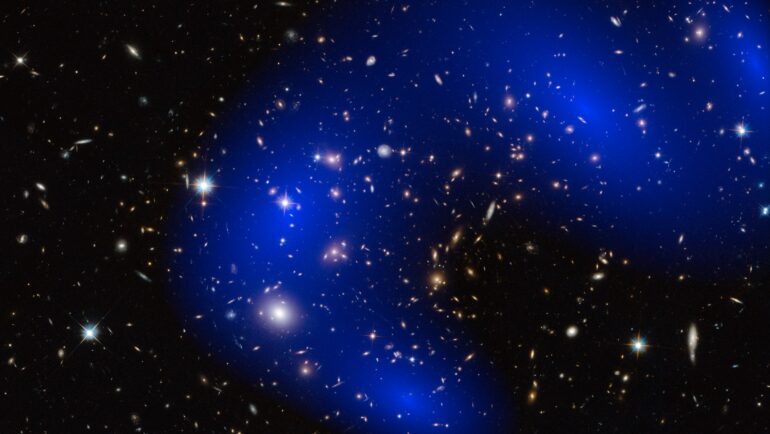
If you look across space with a telescope, you’ll see countless galaxies, most of which host large central black holes, billions of stars and their attendant planets. The universe teems with huge, spectacular objects, and it might seem like these massive objects should hold most of the universe’s matter.
But the Big Bang theory predicts that about 5% of the universe’s contents should be atoms made of protons, neutrons and electrons. Most of those atoms cannot be found in stars and galaxies – a discrepancy that has puzzled astronomers.
If not in visible stars and galaxies, the most likely hiding place for the matter is in the dark space between galaxies. While space is often referred to as a vacuum, it isn’t completely empty. Individual particles and atoms are dispersed throughout the space between stars and galaxies, forming a dark, filamentary network called the “cosmic web.”
Throughout my career as an astronomer, I’ve studied this cosmic web, and I know how difficult it is to account for the matter spread throughout space.
In a study published in June 2025, a team of scientists used a unique radio technique to complete the census of normal matter in the universe.
The census of normal matter
The most obvious place to look for normal matter is in the form of stars. Gravity gathers stars together into galaxies, and astronomers can count galaxies throughout the observable universe.
The census comes to several hundred billion galaxies, each made of several hundred billion stars. The numbers are uncertain because many stars lurk outside of galaxies. That’s an estimated 1023 stars in the universe, or hundreds of times more than the number of sand grains on all of Earth’s beaches. There are an estimated 1082 atoms in the universe.
However, this prodigious number falls far short of accounting for all the matter predicted by the Big Bang. Careful accounting indicates that stars contain only 0.5% of the matter in the universe. Ten times more atoms are presumably floating freely in space. Just 0.03% of the matter is elements other than hydrogen and helium, including carbon and all the building blocks of life.

Looking between galaxies
The intergalactic medium – the space between galaxies – is near-total vacuum, with a density of one atom per cubic meter, or one atom every 35 cubic feet. That’s less than a billionth of a billionth of the density of air on Earth. Even at this very low density, this diffuse medium adds up to a lot of matter, given the enormous, 92-billion-light-year diameter of the universe.
The intergalactic medium is very hot, with a temperature of millions of degrees. That makes it difficult to observe except with X-ray telescopes, since very hot gas radiates out through the universe at very short X-ray wavelengths. X-ray telescopes have limited sensitivity because they are smaller than most optical telescopes.
Deploying a new tool
Astronomers recently used a new tool to solve this…

