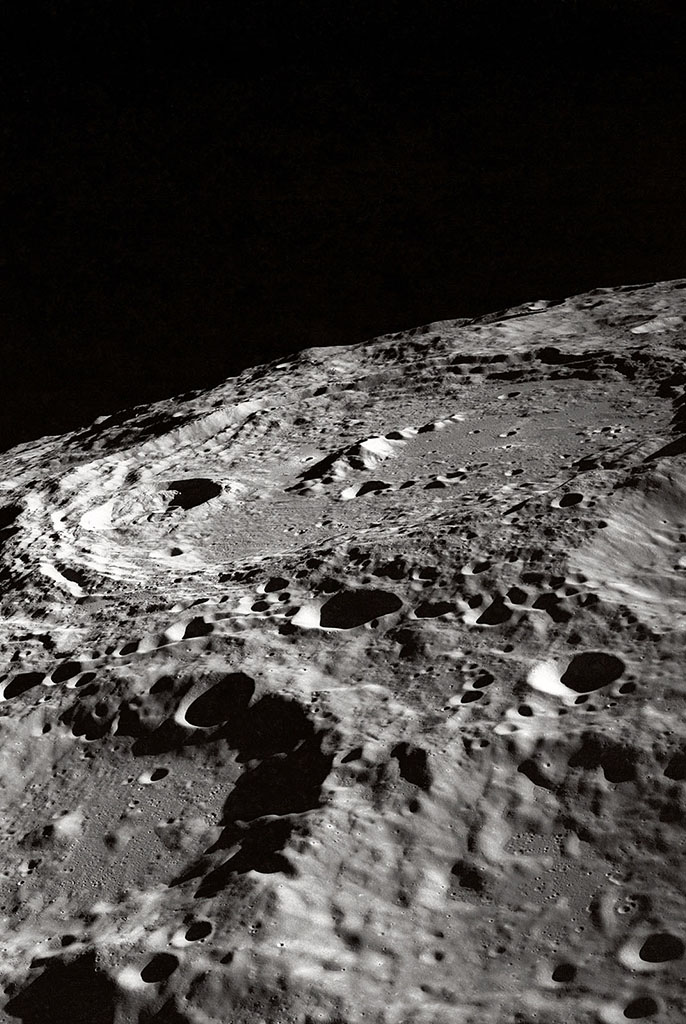
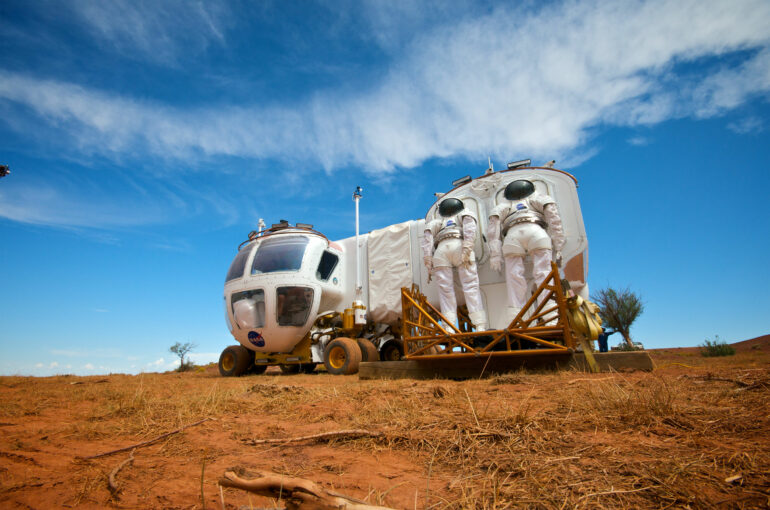
Humanity’s drive to explore has taken us across the solar system, with astronaut boots, various landers and rovers’ wheels exploring the surfaces of several different planetary bodies. These environments are generally hostile to human and equipment health, so designing and executing these missions requires a lot of planning, testing and technological development.
You may have heard about the extensive testing facilities for spacecraft and equipment, but how do scientists prepare for the human aspect of space exploration?
One way to test out techniques and identify situations that may arise during a real mission is using a simulation, which in this field is more commonly known as an analog. Researchers choose and design analog missions and environments to replicate elements of a real mission, using what is available here on Earth.
These missions are conducted in extreme environments on Earth that are comparable to the Moon or Mars, in habitats designed to replicate living quarters, or a combination of both. Researchers can use analogs to study crew performance and procedures, or to test instruments under development for use in space.
For example, operating a drill or wrench may seem easy here on Earth, but try doing the same task in thick gloves on a bulky, pressurized space suit in lower gravity. Suddenly, things aren’t so straightforward. Testing these scenarios on Earth allows researchers to identify necessary changes before launch. The analogs can also train crew members who will one day undertake the actual mission.
I’m a planetary scientist, which means I study the geology of other planets. Currently, I study environments on Earth that are similar to other planets to improve our understanding of their counterparts elsewhere in the solar system. I participated as a volunteer in one of these analog missions as an “analog astronaut,” serving as the crew geologist and applying my prior research findings from studying the surfaces of the Moon and Mars.
These analog missions vary in setting, length and intensity, but all aim to learn more about the human factors involved in space exploration.
Where do we send them?
Analog missions are designed to simulate the crew’s experience in a given mission plan. In some cases, they simulate surface operations on the Moon or Mars for up to a year. Others might replicate the experience of being in transit to Mars for a period of time, followed by the crew “landing” and exploring the surface.

NASA uses several analog mission facilities spread across the world. For example, the Mars Desert Research Station in Utah is located in an environment chosen to imitate conditions on Mars, while analog missions at Aquarius, an undersea research station off the coast of Florida, help scientists learn about crew behavior and psychology in a confined habitat located in a hostile environment.
Some natural environments are commonly used for analog operations, such as volcanic terrains…