After a string of dramatic failures, the huge Starship rocket from SpaceX had a fully successful test on Oct. 13, 2025. A couple more test flights, and SpaceX plans to launch it into orbit.
A month later, a rival rocket company, Blue Origin, flew its almost-as-large New Glenn rocket all the way to orbit and sent spacecraft on their way to Mars.
While these successful flights are exciting news for future missions to the Moon as well as other planets, I’ve argued for several years that these superheavy-lift rockets can also boost research in my own specialty, astronomy – the study of stars and galaxies far beyond our solar system – to new heights.
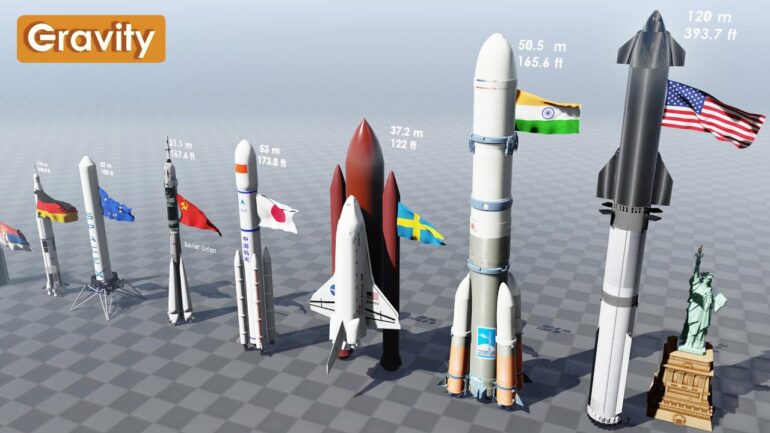
Comparing the sizes of the world’s rockets.
Taking the broad view
Why do I say that? Astronomy needs space. Getting above the atmosphere allows telescopes to detect vastly more of the electromagnetic spectrum than visible light alone. At these heights, telescopes can detect light at much longer and shorter wavelengths, which are otherwise blocked by Earth’s atmosphere.
To get an idea of how that has enriched astronomy, imagine listening to someone play the piano, but only in one octave. The music would sound much richer if they used the full keyboard.
With the broader spectrum in view, astronomers can see objects in the sky that are much colder than stars, but also objects that are far hotter.
How much cooler and hotter? The hottest stars you can see in visible light are about 10 times hotter than the coolest. With the whole infrared-to-X-ray spectrum, the temperatures that come into view can be 1,000 times colder or 1,000 times hotter than regular stars.
Scientists have had nearly 50 years of access to the full light spectrum with sets of increasingly powerful telescopes. Alas, this access has come at an ever-increasing cost, too. The newest telescope is the spectacular James Webb Space Telescope, which cost about US$10 billion and detects a portion of the infrared spectrum. At that forbidding price, NASA can’t afford to match Webb across the spectrum by building its full infrared and X-ray siblings.

NASA’s Great Observatories were designed to detect different regions of the electromagnetic spectrum. Spitzer was decommissioned in 2020, a year before Webb launched.
NASA, ESA, CSA, Joseph Olmsted (STScI)
We’ll have to wait a long time even for one more. The estimated date to launch the next “Great Observatory” is a distant 2045 and may be later. The range of notes astronomers can play will shrink, along with our views of the universe.
Escaping the trap with heavy-lift vehicles
These new rockets give us a chance to escape this trap. For the same cost, they can send about 10 times more mass to orbit, and they have bodies about twice as wide, compared with the rockets that have been in use for decades.
Mass matters because telescopes contain heavy…