
Despite two centuries of evolution, the structure of a modern military staff would be recognizable to Napoleon. At the same time, military organizations have struggled to incorporate new technologies as they adapt to new domains – air, space and information – in modern war.
The sizes of military headquarters have grown to accommodate the expanded information flows and decision points of these new facets of warfare. The result is diminishing marginal returns and a coordination nightmare – too many cooks in the kitchen – that risks jeopardizing mission command.
AI agents – autonomous, goal-oriented software powered by large language models – can automate routine staff tasks, compress decision timelines and enable smaller, more resilient command posts. They can shrink the staff while also making it more effective.
As an international relations scholar and reserve officer in the U.S. Army who studies military strategy, I see both the opportunity afforded by the technology and the acute need for change.
That need stems from the reality that today’s command structures still mirror Napoleon’s field headquarters in both form and function – industrial-age architectures built for massed armies. Over time, these staffs have ballooned in size, making coordination cumbersome. They also result in sprawling command posts that modern precision artillery, missiles and drones can target effectively and electronic warfare can readily disrupt.
Russia’s so-called “Graveyard of Command Posts” in Ukraine vividly illustrates how static headquarters where opponents can mass precision artillery, missiles and drones become liabilities on a modern battlefield.
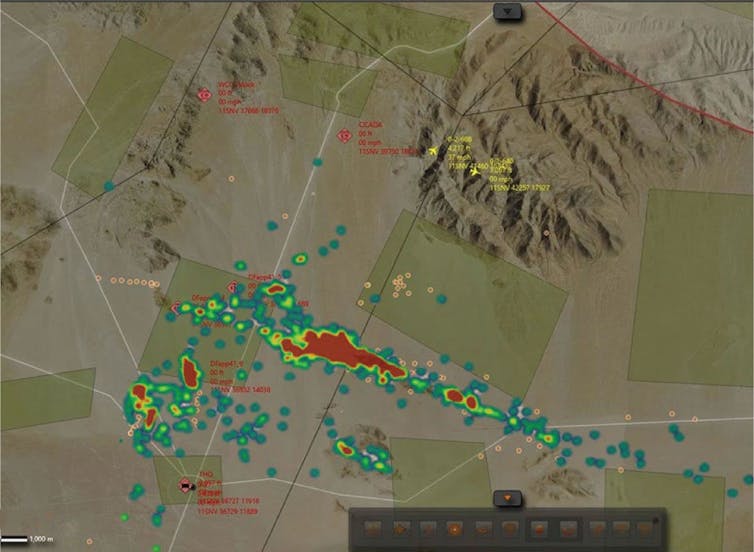
This satellite image shows the electronic emissions of a brigade combat team training at Fort Irwin, Calif. The bright red areas are emissions from command posts.
Col. Scott Woodward, U.S. Army
The role of AI agents
Military planners now see a world in which AI agents – autonomous, goal-oriented software that can perceive, decide and act on their own initiative – are mature enough to deploy in command systems. These agents promise to automate the fusion of multiple sources of intelligence, threat-modeling, and even limited decision cycles in support of a commander’s goals. There is still a human in the loop, but the humans will be able to issue commands faster and receive more timely and contextual updates from the battlefield.

These AI agents can parse doctrinal manuals, draft operational plans and generate courses of action, which helps accelerate the tempo of military operations. Experiments – including efforts I ran at Marine Corps University – have demonstrated how even basic large language models can accelerate staff estimates and inject creative, data-driven options into the planning process. These efforts point to the end of traditional staff roles.
There will still be people – war is a human endeavor – and…