

Almost 2 million years ago, a young ancient human died beside a spring near a lake in what is now Tanzania, in eastern Africa. After archaeologists uncovered his fossilized bones in 1960, they used them to define Homo habilis – the earliest known member of our own genus.
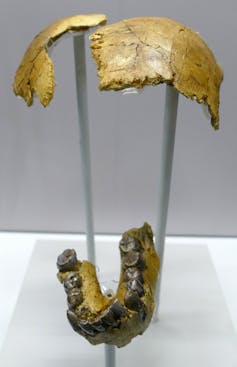
Homo habilis specimen found in 1960.
Universal History Archive/Universal Images Group via Getty Images
Paleoanthropologists define the first examples of the genus Homo based largely on their bigger brains – and, sometimes, smaller teeth – compared with other, earlier ancestors such as the australopithecines – the most famous of these being Lucy. There were at least three types of early humans: Homo habilis, Homo rudolfensis and the best documented species, Homo erectus. At least one of them created sites now in the archaeological record, where they brought and shared food, and made and used some of the earliest stone tools.
These archaeological sites date to between 2.6 to 1.8 million years ago. The artifacts within them suggest greater cognitive complexity in early Homo than documented among any nonhuman primate. For example, at Nyayanga, a site in Kenya, anthropologists recently found that early humans were using tools they transported over distances of up to 8 miles (13 kilometers). This action indicates forethought and planning.
Traditionally, paleoanthropologists believed that Homo habilis, as the earliest big-brained humans, was responsible for the earliest sites with tools. The idea has been that Homo habilis was the ancestor of later and even bigger-brained Homo erectus, whose descendants eventually led to us.
This narrative made sense when the oldest known Homo erectus remains were younger than 1.6 million years old. But given recent discoveries, this seems like a shaky foundation.
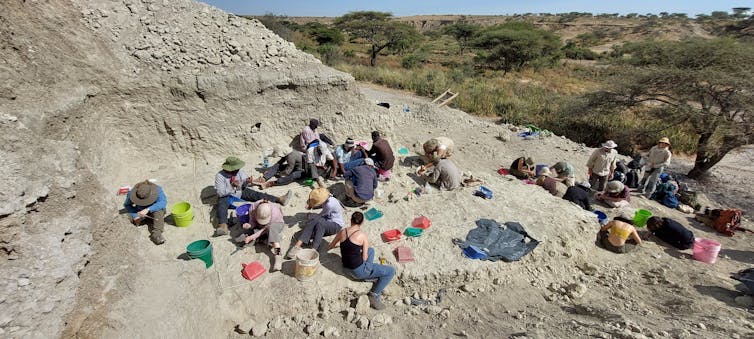
Excavation at Olduvai Gorge of a 1.35-million-year-old site with early human remains. This site in Tanzania has evidence of lots of hunting by early humans: Extinct megafauna like elephants, buffaloes and giraffids were butchered there.
Scott Solomon (Rice University)
In 2015, my team discovered a 1.85 million-year-old hand bone at Olduvai Gorge, the same place the original Homo habilis had been found. But unlike the hand of that Homo habilis juvenile, this fossil looked like it belonged to a larger, more modern, fully land-based rather than tree-based human species: Homo erectus.

Over the past decade, new finds have continued to push back the earliest dates for Homo erectus: about 2 million years ago in South Africa, Kenya and Ethiopia. Taken together, these discoveries reveal that H. erectus is slightly older than the known H. habilis fossils. We cannot simply assume that H. habilis gave rise to H. erectus. Instead, the human family tree looks far bushier than we once thought.
What do all these finds suggest? Only one Homo species is our likely ancestor, and probably only one can be…