
As AI data centers spring up across the country, their energy demand and resulting greenhouse gas emissions are raising concerns. With servers and energy-intensive cooling systems constantly running, these buildings can use anywhere from a few megawatts of power for a small data center to more than 100 megawatts for a hyperscale data center. To put that in perspective, the average large natural gas power plant built in the U.S. generates less than 1,000 megawatts.
When the power for these data centers comes from fossil fuels, they can become major sources of climate-warming emissions in the atmosphere – unless the power plants capture their greenhouse gases first and then lock them away.
Google recently entered into a unique corporate power purchase agreement to support the construction of a natural gas power plant in Illinois designed to do exactly that through carbon capture and storage.
So how does carbon capture and storage, or CCS, work for a project like this?
I am an engineer who wrote a 2024 book about various types of carbon storage. Here’s the short version of what you need to know.
How CCS works
When fossil fuels are burned to generate electricity, they release carbon dioxide, a powerful greenhouse gas that remains in the atmosphere for centuries. As these gases accumulate in the atmosphere, they act like a blanket, holding heat close to the Earth’s surface. Too high of a concentration heats up the Earth too much, setting off climate changes, including worsening heat waves, rising sea levels and intensifying storms.
Carbon capture and storage involves capturing carbon dioxide from power plants, industrial processes or even directly from the air and then transporting it, often through pipelines, to sites where it can be safely injected underground for permanent storage.
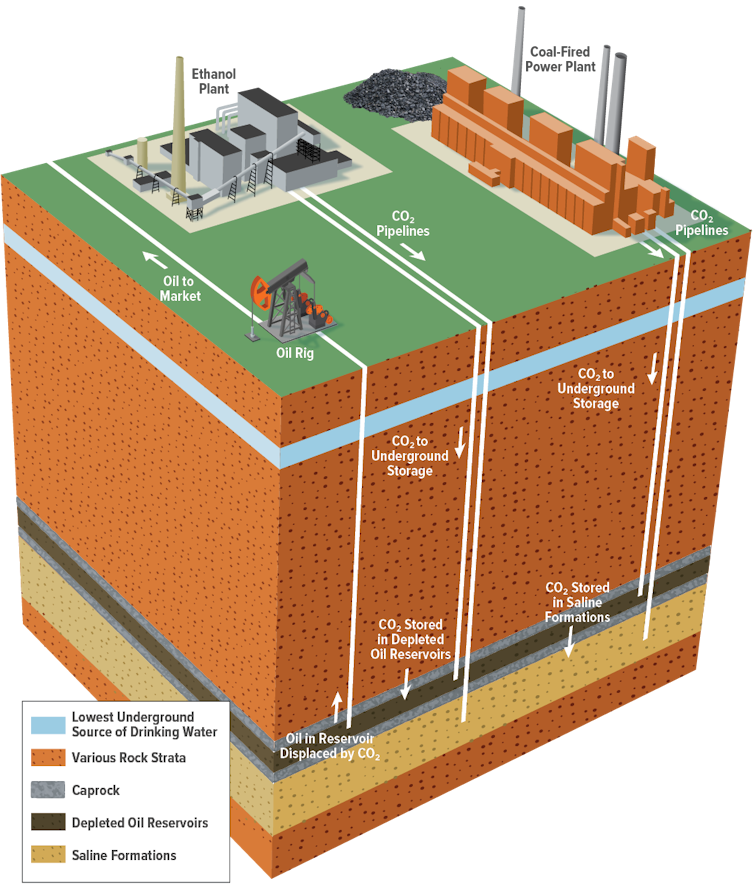
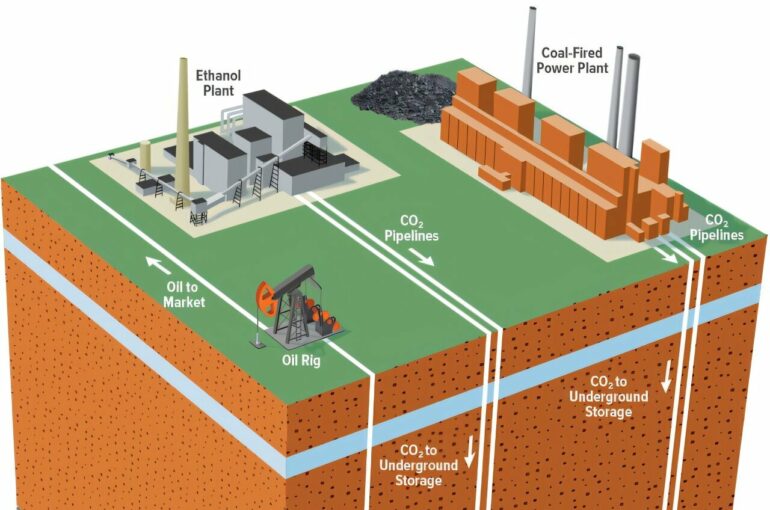
A snapshot of some of the ways carbon capture and storage works. The pipelines into the oil layer, in black, and the oil well illustrate enhanced oil recovery.
Congressional Budget Office, U.S. Federal Government
The carbon dioxide might be transported as a supercritical gas – which is right at the phase change from liquid to gas and has the properties of both – or dissolved in a liquid. Once injected deep underground, the carbon dioxide can become permanently trapped in the geologic structure, dissolve in brine or become mineralized, turning it to rock.
The goal of carbon storage is to ensure that carbon dioxide can be kept out of the atmosphere for a long time.

Types of underground carbon storage
There are several options for storing carbon dioxide underground.
Depleted oil and natural gas reservoirs have plentiful storage space and the added benefit that most are already mapped and their limits understood. They already held hydrocarbons in place for millions of years.
Carbon dioxide can also be injected into working oil or gas reservoirs to push out more of those fossil fuels while leaving most…