

Across the U.S., hundreds of sites on land or in lakes and rivers are heavily contaminated with hazardous waste produced by human activity. Many of these places, designated as Superfund sites by the Environmental Protection Agency, can be found in Houston, Texas, the city where my colleagues and I live and work.
Hazardous contaminants present at these sites that can increase the risk of cancer – such as polycyclic aromatic hydrocarbons, or PAHs – are pervasive in soil and water. Detecting these contaminants is only the first step to cleaning them up and keeping the environment safe.
The EPA’s standard methods for analyzing water samples from a well, for example, involve expensive techniques that must be carried out in a separate location, taking weeks.
Our chemistry research group develops new methods that are more accessible and portable to detect toxic pollutants in soil, water and even blood.
My colleagues and I use machine learning methods to detect individual compounds in mixtures without separating them and to automatically identify those compounds by comparing them to a digital database. With machine learning we can streamline analysis of a contaminated site, detecting hazardous pollutants faster and on-site, for more efficient environmental monitoring.
Nanomaterials are extra sensitive
Imagine trying to look at the end of a strand of your hair head on. You would barely see the width of the tiny filament. Now try to imagine a material that is 1,000 times smaller than the width of that hair strand. You wouldn’t see anything at all. My research uses microscopic objects known as nanoparticles that are about that size.
These nanoparticles interact with light in unique ways – kind of like how a magnifying glass focuses sunlight. Any substances near the nanoparticles are exposed to this focused light. We take advantage of this property by shining a beam of infrared light on the nanoparticles, so the substances around them absorb the intense light and generate a signal. We can detect the signal with a spectrophotometer: an instrument that measures the amount of light of a specific frequency.
Any toxic pollutant near the nanoparticles will absorb more of that infrared light than it normally would, enhancing the signal that we can measure. This process occurs only when the pollutant is close to the nanoparticles’ surface. But even the smallest concentrations of these pollutants can be detected using the nanoparticles’ enhancement, if they’re nearby.
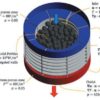
In our laboratory, I make the nanoparticles using solutions of metal salts. I then dissolve them in a liquid to make an ink, which I then paint onto glass microscope plates. After the ink dries, I am left with nanoparticles packed together on the surface of the glass, like beads on a diamond painting kit.