
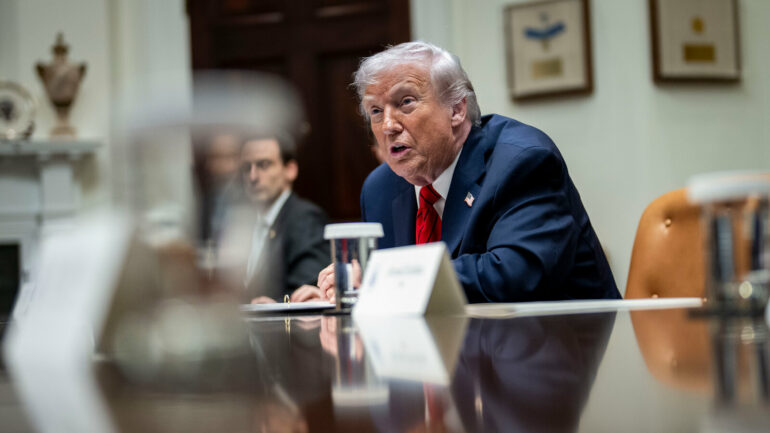
President Donald Trump signed an executive order on Dec. 11, 2025, that aims to supersede state-level artificial intelligence laws that the administration views as a hindrance to innovation in AI.
State laws regulating AI are increasing in number, particularly in response to the rise of generative AI systems such as ChatGPT that produce text and images. Thirty-eight states enacted laws in 2025 regulating AI in one way or another. They range from prohibiting stalking via AI-powered robots to barring AI systems that can manipulate people’s behavior.
The executive order declares that it is the policy of the United States to produce a “minimally burdensome” national framework for AI. The order calls on the U.S. attorney general to create an AI litigation task force to challenge state AI laws that are inconsistent with the policy. It also orders the secretary of commerce to identify “onerous” state AI laws that conflict with the policy and to withhold funding under the Broadband Equity Access and Deployment Program to states with those laws. The executive order exempts state AI laws related to child safety.
Executive orders are directives to federal agencies on how to implement existing laws. The AI executive order directs federal departments and agencies to take actions that the administration claims fall under their legal authorities.
Big tech companies have lobbied for the federal government to override state AI regulations. The companies have argued that the burden of following multiple state regulations hinders innovation.
Proponents of the state laws tend to frame them as attempts to balance public safety with economic benefit. Prominent examples are laws in California, Colorado, Texas and Utah. Here are some of the major state laws regulating AI that could be targeted under the executive order:
Algorithmic discrimination
Colorado’s Consumer Protections for Artificial Intelligence is the first comprehensive state law in the U.S. that aims to regulate AI systems used in employment, housing, credit, education and health care decisions. However, enforcement of the law has been delayed while the state legislature considers its ramifications.
The focus of the Colorado AI act is predictive artificial intelligence systems, which make decisions, not newer generative artificial intelligence like ChatGPT, which create content.

The Colorado law aims to protect people from algorithmic discrimination. The law requires organizations using these “high-risk systems” to make impact assessments of the technology, notify consumers whether predictive AI will be used in consequential decisions about them, and make public the types of systems they use and how they plan to manage the risks of algorithmic discrimination.
A similar Illinois law scheduled to take effect on Jan. 1, 2026, amends the Illinois Human Rights Act to make it a civil rights violation for employers to use AI tools that result in discrimination.