In the middle of the South Pacific, a group of Fijian plants have solved a problem that has long puzzled scientists: How can an organism cooperate with multiple partners that are in turn competing for the same resources? The solution turns out to be simple – compartmentalization.
Imagine an apartment building where unfriendly neighbors might clash if they run into each other, but smart design keeps everyone peacefully separated. In our new research published in the journal Science, we show how certain plants build specialized structures that allow multiple aggressive ant species to live side by side inside them without ever meeting.
Ants and plants cooperate in Fijian rainforest
Squamellaria plants are epiphytes – meaning they don’t have roots attached to the ground, and instead grow on another plant for physical support. They live high up in the rainforest canopy, in the South Pacific.
Because they don’t have direct access to the soil’s nutrients, Squamellaria plants have evolved an original strategy to acquire what they need: In a mutually beneficial relationship, they grow structures that appeal to ants looking for a place to live. This kind of long-term relationship between species – whether helpful or harmful – is called symbiosis.
Here’s how it works in this case. The base of the Squamellaria plant stem forms a swollen, hollow structure called a domatium – a perfect place for ants to live. Domatia gradually enlarge to the size of a soccer ball, containing ever more plant-made houses ready for ants to move into. Each apartment can house a colony made up of thousands of ants.
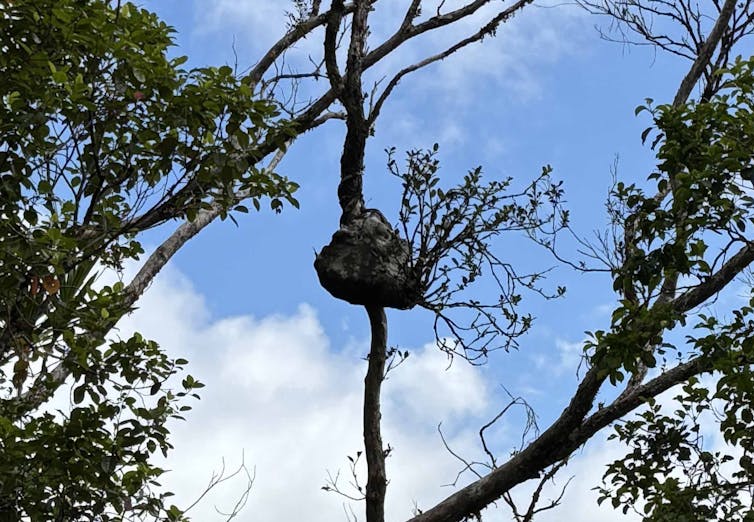
A multicompartment Squamellaria (S. tenuiflora) in its natural habitat: rainforests in Fiji. This large plant likely contains a dozen or more compartments.
G. Chomicki
The relationship between the ants and the plants is mutualistic, meaning both parties benefit. The ants gain a nice sturdy and private nest space, while the plants gain essential nutrients. They obtain nitrogen and phosphorus from the ants’ feces and from detritus – including dead insects, plant bits and soil – that the ants bring inside the domatium.
However, tropical rainforest canopies are battlegrounds for survival. Ants compete fiercely for nesting space, taking over any hollow branch or space under tree bark. Any Squamellaria ant house would thus be at risk of being colonized and taken over by other incoming ants, disrupting the existing partnership.

Until now, it was unclear how the cooperative relationships between ants and plants remain stable in this competitive environment.
Walls keep the peace
Our first hint about what keeps the peace in the Squamellaria real estate came when we discovered several ant species living in the same plant domatium. This finding just didn’t make sense. How could aggressively competing ant species live together?
We investigated the structure of domatia using computed-tomography…