When you’re on a camping trip, you might have to pack your own food and maybe something to filter or treat water that you find. But imagine your campsite is in space, where there’s no water, and packing jugs of water would take up room when every inch of cargo space counts. That’s a key challenge engineers faced when designing the International Space Station.
Before NASA developed an advanced water recycling system, water made up nearly half the payload of shuttles traveling to the ISS. I am an environmental engineer and have conducted research at Kennedy Space Center’s Space Life Sciences Laboratory. As part of this work, I helped to develop a closed-loop water recovery system.
Today, NASA recovers over 90% of the water used in space. Clean water keeps an astronaut crew hydrated, hygienic and fed, as it can use it to rehydrate food. Recovering used water is a cornerstone of closed-loop life support, which is essential for future lunar bases, Mars missions and even potential space settlements.
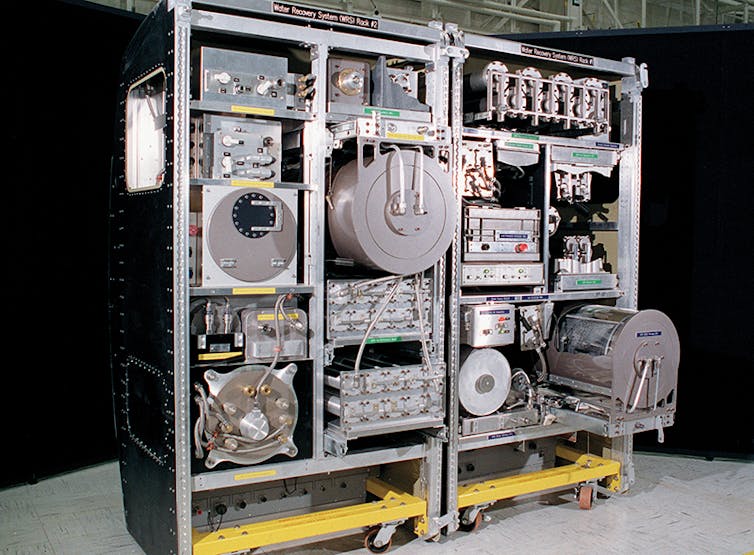
A close-up view of the water recovery system’s racks – these contain the hardware that provides a constant supply of clean water for four to six crew members aboard the ISS.
NASA
NASA’s environmental control and life support system is a set of equipment and processes that perform several functions to manage air and water quality, waste, atmospheric pressure and emergency response systems such as fire detection and suppression. The water recovery system − one component of environmental control and life support − supports the astronauts aboard the ISS and plays a central role in water recycling.
Water systems built for microgravity
In microgravity environments like the ISS, every form of water available is valuable. The water recovery systems on the ISS collect water from several sources, including urine, moisture in cabin air, and hygiene – meaning from activities such as brushing teeth.
On Earth, wastewater includes various types of water: residential wastewater from sinks, showers and toilets; industrial wastewater from factories and manufacturing processes; and agricultural runoff, which contains fertilizers and pesticides.
In space, astronaut wastewater is much more concentrated than Earth-based wastewater. It contains significantly higher levels of urea – a compound from urine – salts, and surfactants from soaps and materials used for hygiene. To make the water safe to drink, the system needs to remove all of these quickly and effectively.

The water recovery systems used in space employ some of the same principles as Earth-based water treatment. However, they are specifically engineered to function in microgravity with minimal maintenance. These systems also must operate for months or even years without the need for replacement parts or hands-on intervention.
NASA’s water recovery system captures and recycles nearly all forms of water used or generated aboard the…