
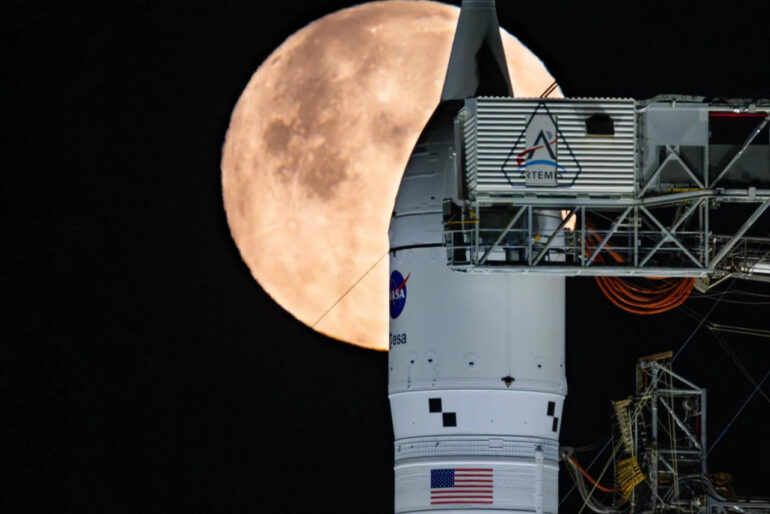
Throughout February 2026, people at the Kennedy Space Center got to witness an exciting sight: NASA’s behemoth Space Launch System rocket, SLS, standing on the launch pad, aimed toward the sky. The launch system has been key to the Artemis program – an ambitious series of missions intended to culminate in a sustained human presence on the Moon. NASA had initially planned to launch the second Artemis mission, which would take a crew of four people around the Moon, in February.
But as anticipation for launch built, an issue with the liquid propellant arose. A few days later, the SLS faced another problem, this time with the rocket’s upper stage, and had to roll back from the pad.
I’m an aerospace expert who is deeply passionate about aerospace technology and what it means for the U.S. and humanity’s future. I’ve been following the Artemis program’s timeline – February 2026 has represented a pivotal moment for U.S. spaceflight. Artemis II faced a number of delays, and NASA officials announced a shake-up of the larger program’s timeline.

NASA’s Artemis II SLS Moon rocket, along with the Orion spacecraft, slowly rolls back toward the vehicle assembly building at the Kennedy Space Center on Feb. 25, 2026.
AP Photo/John Raoux
Springing leaks
It started on Feb. 2, during Artemis II’s first wet dress rehearsal. During this major test, engineers assemble all components of the Space Launch System and fill its tanks with a combined 700,000 gallons of super-cold liquid hydrogen and liquid oxygen. These liquids act as the propellant for the rocket during launch.
During the test, the team detected a hydrogen leak at the interface of a 33‑foot-high (10 meters) service mast, the removable structure that brings the hydrogen and oxygen to the tank. They attributed the cause of the issue to moisture accumulated in the Teflon seal of two interfaces between that mast and the vehicle’s tank.
On the following day, NASA decided to postpone the launch until March 6. A new wet dress rehearsal would take place on Feb. 19 to verify everything was working as expected.
On the day of the second wet dress rehearsal, hydrogen operations proceeded smoothly, seemingly confirming plans for a March launch for Artemis II. Engineers at NASA likely breathed a sigh of relief, but they did so too early. A couple of days later another problem surfaced: They found the exploration upper stage was leaking helium. This upper stage of the rocket kicks in above 62 miles (100 kilometers), once the core stage expends all its propellant.

Because helium is essential for pressurizing cryogenic tanks and for purging the pipelines that will carry highly reactive liquid oxygen, the leak raised concerns.
Notably, these issues echoed the challenges SLS encountered ahead of its first launch for the Artemis I mission in 2022. Artemis I launched nearly six years after NASA’s original target date, ultimately

