

Curious Kids is a series for children of all ages. If you have a question you’d like an expert to answer, send it to [email protected].
Do we visualize dreams in color or black and white? – Srihan, age 7, West Bengal, India
Dreams are an astonishing state of consciousness. As you sleep, your mind creates fantastic and bizarre stories, rich with visual details – all without any conscious input from you.
Some dreams are boring. Others show you shocking events or magnificent images. I frequently dream of alligators walking upright, wearing sunglasses and yellow T-shirts. Often the alligators are friendly and go on adventures with me, but sometimes they’re aggressive and chase me.
The way the brain operates while you’re dreaming explains why dreams can be so fantastic. A small structure called the amygdala is largely responsible for processing emotional information, and it’s very active while dreaming. In contrast, the brain’s frontal cortex, which helps you plan and strategize, tends to be rather quiet. This pattern explains why dreams can jump from one peculiar scene to the next, with no clear story line. It’s as if you are sailing an emotional wave, without a captain.
Dreams can indeed be emotional and sometimes scary. But dreams can be enjoyable too – maybe you’ve had a dream so delightful you were disappointed to wake up and realize it wasn’t reality.
Are the images in your dreams in vivid color? Perhaps you had a dream about playing Candy Crush and can remember the brightly colored red, purple and yellow candies cascading in your dream.
As a neuroscientist who studies sleep, I can tell you that about 70% to 80% of people report dreaming in color, as opposed to just in shades of black and white. But this estimate may be low, because scientists can’t actually see what a dreamer sees. There’s no sophisticated technology showing them exactly what’s happening in a dreamer’s mind. Instead, they have to rely on what dreamers remember about their dreams.

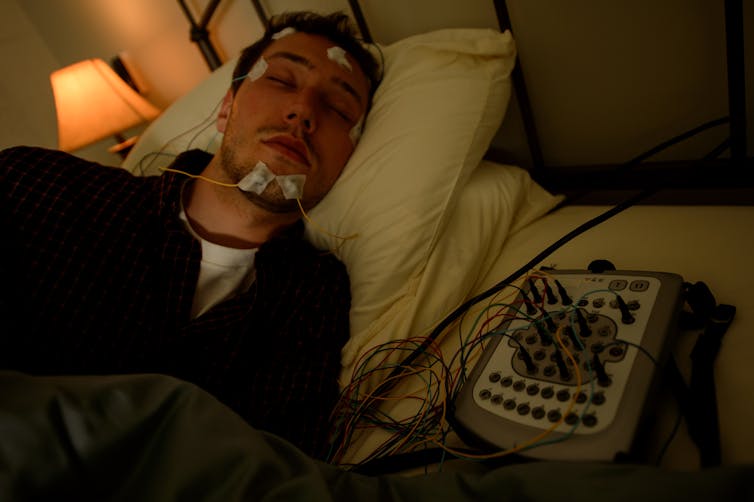
Researchers record brain and eye activity while they monitor volunteers’ sleep in the lab.
Greg Kohuth
Studying sleep in the laboratory
To study dreams, researchers ask people to sleep in laboratories, and they simply wake them while they’re dreaming and then ask them what they were just thinking about. It’s pretty rudimentary science, but it works.
How do scientists know when people are dreaming? Although dreams can occur in any sleep stage, research has long shown that dreams are most likely to occur during rapid eye movement sleep, or REM sleep.
Scientists can identify REM by the electrical activity on your scalp and your eye movements. They do this by using an electroencephalogram, which uses several small electrodes placed directly on the scalp to measure brain activity. During REM, the dreamer’s eyes move back and forth repeatedly. This