
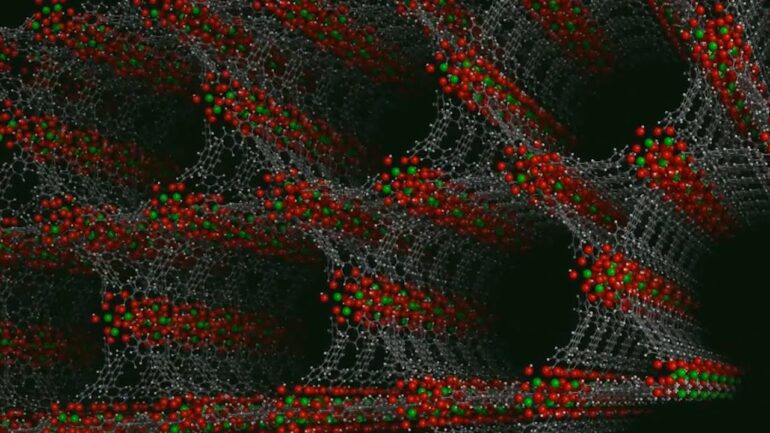
The 2025 Nobel Prize in chemistry was awarded to Richard Robson, Susumu Kitagawa and Omar Yaghi on Oct. 8, 2025, for the development of metal-organic frameworks, or MOFs, which are tunable crystal structures with extremely high porosity. These are a class of materials that have truly changed the way scientists design and think about matter, inspiring progress in various applications.
I’m a MOF scientist and for many of us in the field, this recognition feels both historic and deeply personal. MOFs are not just elegant crystals you’d admire under a microscope; they’re an entire universe of structures, each like a miniature city of tunnels and rooms waiting to be filled. They’ve been my scientific home since I first stepped into research, and they still feel a little bit like magic to me.
So, what exactly are MOFs?
Metal-organic frameworks are like crystalline scaffolds built from two ingredients: metals that act like connective joints and organic – that is, carbon-based – molecules that behave as bridges to link those joints in a repeating pattern. The result is a highly ordered, porous framework – a kind of molecular architecture that’s both sturdy and full of empty space.
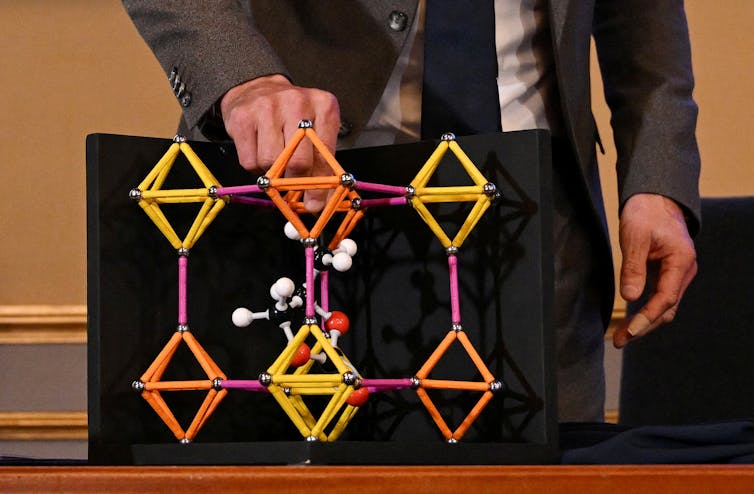
Metal-organic frameworks, shown in this model, can trap smaller molecules inside their larger frame.
Jonathan Nackstrand/AFP via Getty Images
These frameworks are so porous, like sponges with tiny voids, that it’s almost impossible to picture them. One gram of a MOF has so many pores that it can expose as much internal surface area as a soccer field. It’s astonishing that a handful of powder could hide an entire landscape of surface within it.
That enormous surface area is one of the unique things that make MOFs so powerful, and it comes from the nanoscale pores – tiny molecular rooms that can trap, separate, transform or transport gases, ions and other molecules. In a way, MOFs are like molecular hotels with countless doors, each programmed to admit only certain guests.
Why scientists love them
What fascinates me most about metal-organic frameworks is their limitless design space. Just by glancing at the periodic table, every metal could, in principle, serve as a cornerstone, and countless organic molecules can act as bridges connecting them. Even using the same combination can produce entirely different architectures.

Chemist Omar Farha compares metal-organic frameworks to Lego sets that you can build and customize.
So far, scientists have synthesized over 90,000 MOFs, and computational chemists have predicted hundreds of thousands more. Few material families offer this much versatility.
I like to think of MOFs as puzzles or Lego sets, but on the atomic scale. You can replace a single piece, or change its color or shape, and end up with a material that behaves completely differently.
Add a new “decoration” – what chemists…