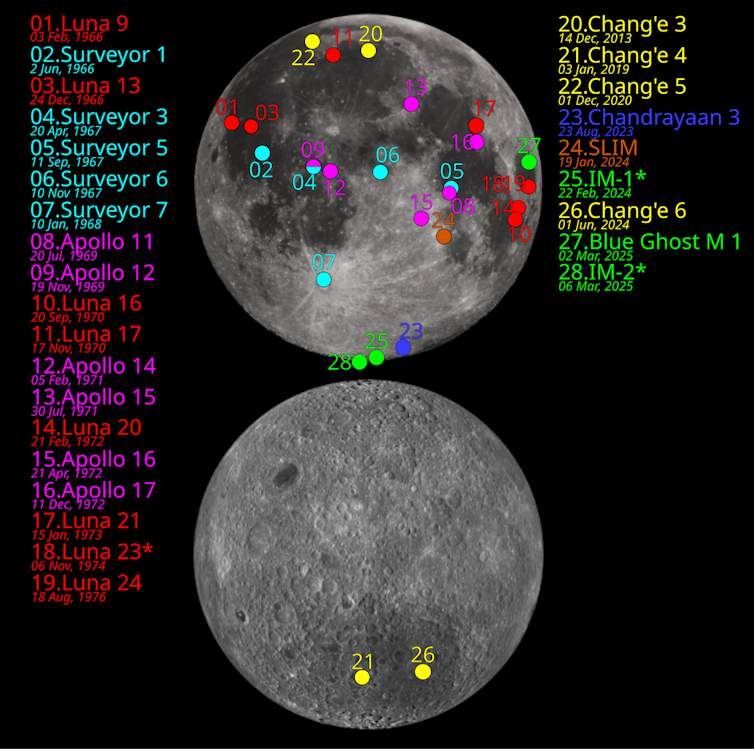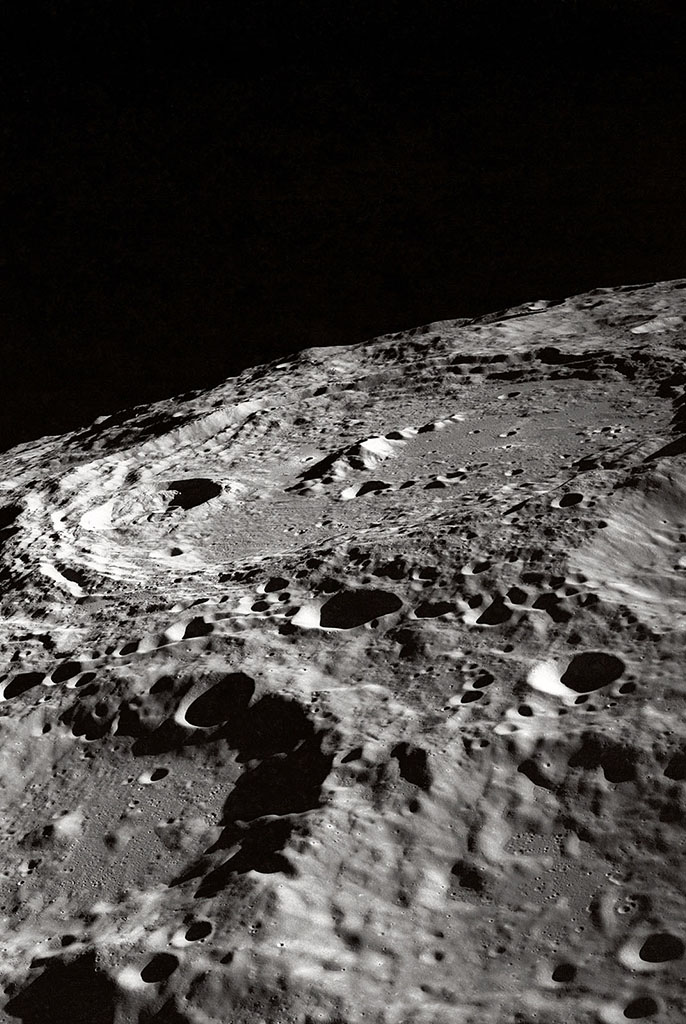
Interest in the Moon has been high – just in the past two years there have been 12 attempts to send missions to the Moon, nearly half of which private companies undertook. With so much activity, it’s important to start thinking about coordination and safety.
To some, this concern may seem premature. About 10 to 20 missions are headed to the Moon in the next few years – far short of the thousands of satellites operating in Earth’s orbit. And the area around the Moon, referred to as cislunar space, is very large. Earth’s orbital area is often considered to extend from near Earth out to geostationary orbit, where a spacecraft orbits at a speed that makes it appear stationary from the Earth’s surface.
Cislunar space extends from geostationary orbit out to the Moon – an area with a volume 2,000 times larger than Earth’s orbital area. This size discrepancy seems to suggest crowding around the Moon may not be an immediate concern.
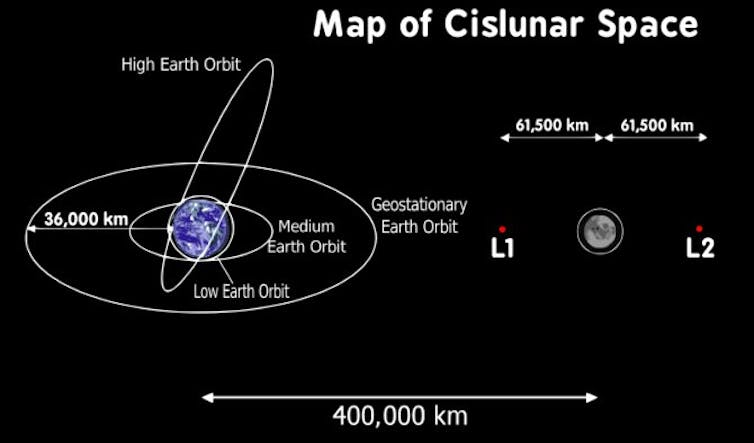
Cislunar space refers to the space between Earth’s geostationary orbit and the Moon.
Many Worlds, CC BY-NC
However, missions tend to choose from a select set of stable orbits around the Moon, so the vastness of cislunar space may be misleading when thinking about whether missions will intersect. Also, most government sensors that track spacecraft aren’t capable of consistently detecting and monitoring objects so far away from Earth, partly due to the glare from the Moon itself.
That uncertainty, combined with the high cost of lunar missions, makes operators more likely to move their spacecraft to avoid a collision, even when the probability of a collision is quite low.
As an interdisciplinary team combining space policy and astrodynamics expertise, we’ve been studying how companies and space agencies could manage traffic in lunar orbit without unnecessary maneuvers. Our research, published in March 2025 in the Journal of Spacecraft and Rockets, shows that due to the popularity of certain orbits and the uncertainties regarding each spacecraft’s location, potential collisions become an issue surprisingly quickly.
Our simulations show that with only 50 satellites in lunar orbit, each of those satellites will need to maneuver four times a year on average to avoid a potential crash – a significant cost in terms of fuel as well as potential disruption to mission objectives. Lunar orbit could easily reach that number of satellites within a decade if activity continues to increase.