
James Dewey Watson was an American molecular biologist most known for co-winning the 1962 Nobel Prize in physiology or medicine for discovering the structure of DNA and its significance in transferring information in living systems. The importance of this discovery cannot be overstated. It unlocked how genes work and gave birth to the fields of molecular biology and evolutionary phylogenetics. It has inspired and influenced my career as a scientist and as director of a bioinformatics and functional genomics research center.
Watson was also an outspoken and controversial figure who transformed the way science was communicated. He was the first high-profile Nobel laureate to give the general public a shockingly personal and unfiltered glimpse into the cutthroat and competitive world of scientific research. Watson died on Nov. 6, 2025 at age 97.
Watson’s pursuit of the gene
Watson attended the University of Chicago at age 15, initially intending to become an ornithologist. After reading Erwin Schrödinger’s book of collected public lectures on the chemistry and physics of how cells operate, “What is Life?,” he became interested in finding out what genes are made of – the biggest question in biology at the time.
Chromosomes – a mixture of protein and DNA – were known to be the molecules of heredity. But most scientists were convinced that proteins, with 20 different building blocks, were the likely candidate as opposed to DNA with only four building blocks. When the 1944 Avery-MacLeod-McCarty experiment demonstrated that DNA was the carrier molecule of inheritance, the focus immediately shifted to understanding DNA.
Watson completed his doctorate in zoology at Indiana University in 1950, followed by a year in Copenhagen studying viruses. He met biophysicist Maurice Wilkins at a conference in 1951. During Wilkins’ talk on the molecular structure of DNA, Watson saw preliminary X-ray photographs of DNA. This prompted him to follow Wilkins to the Cavendish Laboratory at the University of Cambridge to pursue work into uncovering the structure of DNA. Here, Watson met physicist-turned-biologist Francis Crick and developed an immediate bond with him over their shared research interests.
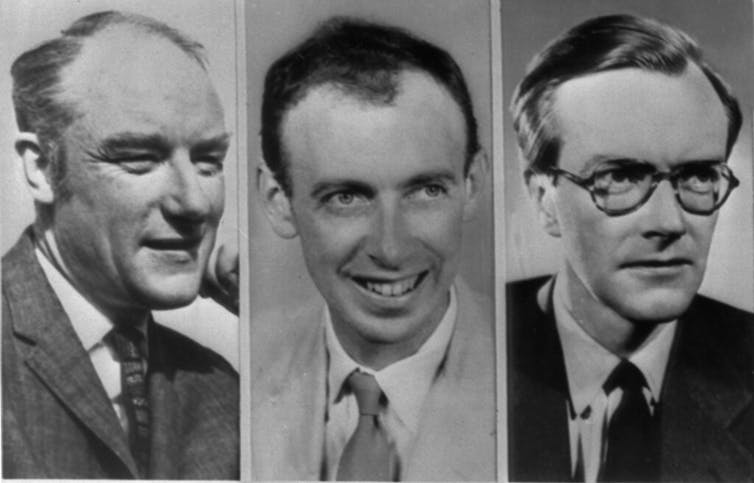
Watson, at center, was jointly awarded the 1962 Nobel Prize in medicine with Francis Crick, left, and Maurice Wilkins.
AP Photo
Soon, Watson and Crick published their seminal findings on the structure of DNA in the journal Nature in 1953. Two other papers were also published in the same journal issue on the structure of DNA, one co-authored by Wilkins and the other co-authored by chemist and X-ray crystallographer Rosalind Franklin.
Franklin took the X-ray photographs of DNA crystals that contained the data necessary for solving the structure of DNA. Her work, taken together with the work of the Cavendish Laboratory members, led to the 1962 Nobel Prize in physiology or medicine awarded to Watson,…

