
In the most talked-about film from the final year of the 20th century, “The Matrix,” a computer hacker named Neo finds that the world he lives and works in isn’t real. It’s a virtual reality, created by artificial intelligence.
At the time, the idea seemed like science fiction. In the years since, however, that concept has become an increasingly credible theory: “the simulation hypothesis.” This theory posits that, like Neo, living things are characters inside a computer-generated simulation – or, as I describe in my 2025 book, a massively multiplayer video game. In this hypothesis, the physical world around us is actually part of a virtual reality.
Simulation theory raises the kind of questions once reserved for mystics and religious scholars: Why are we here? Is there more to reality than we can see? Is there a creator? Are we more than our physical bodies?
The science and technology may be modern, but in some ways, this hypothesis echoes ideas that faith traditions have explored for centuries.
Living in a game?
Simulation theory became popular from the work of philosopher Nick Bostrom, particularly a paper he published in 2003. The basic argument goes like this: If technology continues to improve, humans will be able to build virtual worlds indistinguishable from physical reality, and AI characters indistinguishable from biological beings. This suggests it’s possible that a more advanced civilization has already reached that point – and that we are inside one of their simulations.
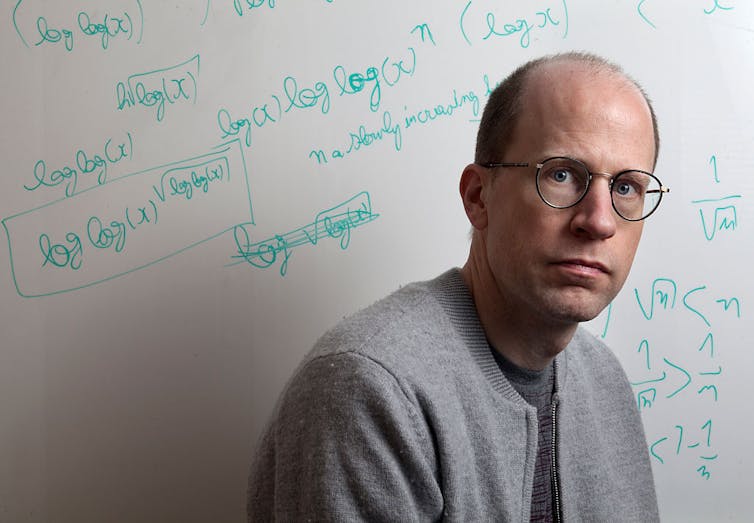
Philosopher Nick Bostrom, pictured in 2015, first proposed the simulation hypothesis in 2003.
Tom Pilston for The Washington Post via Getty Images
Physicists, mathematicians, technologists and computer scientists have jumped into the game. Opinions span a wide range of probabilities. Columbia University astronomer David Kipping tried to evaluate the odds we live in a simulation and came up with about 50/50. Some thinkers doubt that the question is even answerable, while others think the theory is impossible – like a 2025 paper arguing that no purely algorithmic system can explain the universe.
The simulation hypothesis does not have to mean that people in the simulation are only soulless, computed AI inside someone else’s creation. In “The Matrix,” for example, even though Neo and other humans are characters inside the simulation, they also existed outside of the virtual world.

Higher intelligence
Simulation theory implies there is a greater intelligence than our own that exists beyond the physical world and may have created our universe – echoing foundational beliefs in many religious traditions. Transhumanist philosopher David Pearce, in fact, called Bostrom’s argument “the first interesting argument for the existence of a Creator in 2000 years.”
The Abrahamic religions of Judaism, Christianity and Islam, for example, all worship a single creator. The biblical Book of…