
If you’ve spent any time in the gardening corners of social media lately, you’ve likely come across a trend called “chaos gardening.”
The name alone is eye-catching – equal parts fun, rebellious and slightly alarming. Picture someone tossing random seeds into bare soil, watering once or twice, and ending up with a backyard jungle of blooms. No rows, no color coordination, no spacing charts. Just sprinkle and hope for the best.
As a sustainable landscape specialist at Colorado State University Extension, I think a lot about how to help people make designed landscapes more sustainable. Occasionally, a new trend like this one crops up claiming to be the silver bullet of gardening – supposedly it saves water, saves the bees and requires no maintenance.
But what is chaos gardening, really? And does it work? As with most viral trends, the answer is: sometimes.
What chaos gardening is and isn’t
At its core, chaos gardening is the practice of mixing a wide variety of seeds, often including leftover packets, wildflower mixes, or cut flower favorites, and scattering them over a planting area with minimal planning.
The goal is to create a dense, colorful garden that surprises you with its variety. For many, it’s a low-pressure, joyful way to experiment.
But chaos gardening isn’t the same as ecological restoration, pollinator meadow planting or native prairie establishment. Unlike chaos gardening, all of these techniques rely on careful species selection, site prep and long-term management.
Chaos gardening is a bit like making soup from everything in your pantry – it might be delicious, but there are no guarantees.
Chaos gardening’s appeal
One reason chaos gardening may be catching on is because it sidesteps the rules of garden design. A traditional landscape design approach is effective and appropriate for many settings, but it is a time investment and can feel intimidating. Design elements and principles, and matching color schemes, don’t fit everyone’s style or skill set.
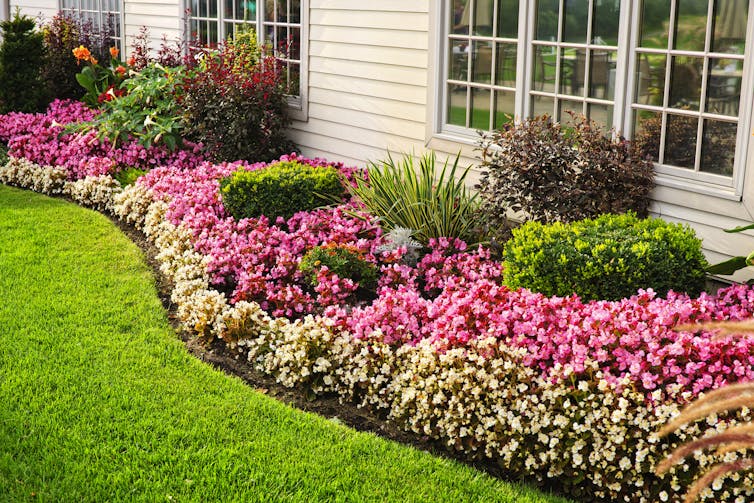

Organized and manicured home gardens such as this can be stressful to maintain.
Elenathewise/iStock via Getty Images Plus
Even the apparently relaxed layers of blooms and informal charm of an English cottage garden actually result from careful planning. Chaos gardening, by contrast, lets go of control. It offers a playful, forgiving entry point into growing things. In a way, chaos gardening is an antidote to the pressure of perfection, especially the kind found in highly curated, formal landscapes.
There’s also the allure of ease. People want gardening to be simple. If chaos gardening brings more people into the joy and mess of growing things, I consider that a win in itself. Broader research has found that emotional connection and accessibility are major motivators for gardening, often more than environmental impact.
When does chaos gardening work?
The best outcomes from chaos gardening…