
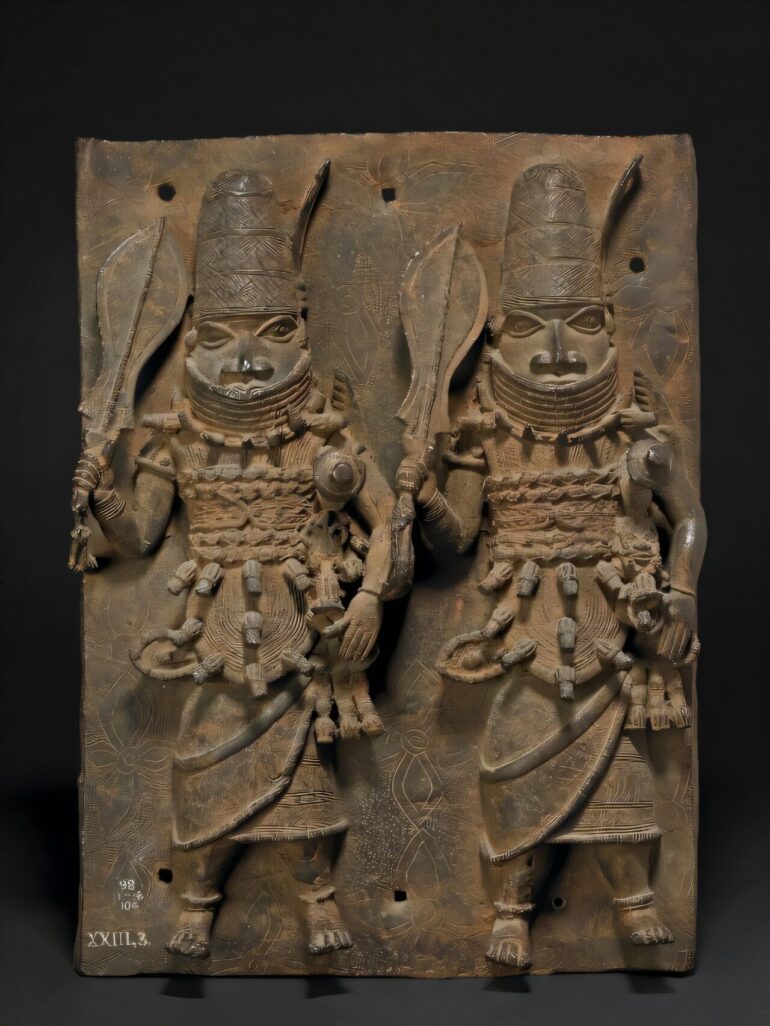
Archaeological excavation in Benin City, Nigeria, ahead of the construction of the Museum of West African Art (MOWAA) has uncovered previously un-investigated sectors of the Kingdom of Benin’s pre-colonial historic palace, shedding light on the powerful West African kingdom’s urban development and renowned artisanal practices.
Benin City was the capital of the Kingdom of Benin: an influential empire that traded across Africa and beyond, impressing visitors from around the known world, including with its masterful crafts such as the iconic Benin Bronzes.
However, Benin City’s royal palace, seat of the Oba (king), was destroyed and looted in AD 1897 during a British raid, wiping out the kingdom and turning it into a center of colonial occupation.
As modern Benin City continues to develop, new buildings are being planned for the area where destroyed areas of the historic palace once stood. Working in advance of the construction, a partnership team of MOWAA, the National Commission for Museums and Monuments (NCMM), and the British Museum are excavating at the historic palace site for the first time in 50 years, providing new insights into the history of this influential kingdom. Their results are published in Antiquity.
“We know that we cannot arrest development: roads must be built, houses must be built. But as we are developing and constructing, we must also make sure that cultural heritage is not destroyed,” says Segun Opadeji, the MOWAA archaeology lead on the project. “We cannot make progress without understanding the past; you must protect your past so that the two can be linked together.”
The MOWAA Institute itself is one of the buildings being constructed here, so will, fittingly, provide a facility for the storage, conservation and research of West African archaeology, including the discoveries made during this project.
“The archaeological project is breaking ground for the MOWAA Institute, and it’s quite unusual to see, directly from your work, a new building and institution developing,” says British Museum research lead on the project, Dr. Sam Nixon. “This is a really important new initiative. It’s very important for the British Museum to be partnering to support this and we’re very much looking forward to ongoing collaboration.”
The researchers uncovered an archaeological sequence stretching from before the Benin Kingdom’s foundation all the way up to its fall and post-colonial development, establishing the most complete architectural sequence for Benin City to date and finding evidence for artisanal activity, including Benin’s renowned metalworking.
Alongside providing an unprecedented opportunity to trace the city’s urban development, these findings have significant implications for our wider understanding of the West African past, shedding light on architecture, artisanal practice, trade, diet and more.
In supporting the development of the new world-class MOWAA research institute, the project has provided state-of-the-art equipment for the new archaeological team and facilitated the training of early career researchers in Nigeria. Another important aspect of the project has been outreach with local communities, including schools, helping to carry West African heritage into the future.
“I think for MOWAA, the outcome has been part of the objective of the project from the beginning, and that is creating a center of excellence for heritage and its management,” concludes lead author and MOWAA research lead on the project, Professor Caleb Folorunso.
“It will be a place where people can come and interact, particularly from West African countries. The facilities we expect to have in place will attract people from around Africa, and it will also help people to immediately conduct research, instead of looking abroad for sample analysis.”
More information:
MOWAA Archaeology Project: enhancing understanding of Benin City’s historic urban development and heritage through pre-construction archaeology, Antiquity (2025). doi.org/10.15184/aqy.2025.10189
Citation:
Pre-construction archaeology reveals Benin City’s historic urban development and heritage (2025, October 29)