
Curious Kids is a series for children of all ages. If you have a question you’d like an expert to answer, send it to [email protected].
What is meant by solar storm and solar wind? – Nihal, age 11, Amalapuram, India
Every day on Earth, you experience weather. You feel the wind blowing and see clouds move across the sky. Sometimes there are storms where the wind gets really strong, it might rain, or there might be thunder and lightning.
Did you know that there’s weather in space too? It all starts with the Sun.
The Sun: The bright star in our solar system
The Sun is a very hot, very big ball of gas at the center of our solar system. Its surface can reach a blistering 10,800 degrees Fahrenheit (6,000 degrees Celsius). That’s nearly five times hotter than lava that spews from volcanoes on Earth, and just like lava, the Sun glows from the heat.
The Sun is made up of what solar physicists like us call plasma.
Normal gases, like the air you breathe on Earth, are made up of atoms bouncing around. Atoms consist of a positively charged bundle of particles called the nucleus and negatively charged particles called electrons. The nucleus and the electrons are tightly stuck together so that atoms are overall neutral – that is, they have no charge.
A gas becomes a plasma when the atoms it’s made of become so hot that their negatively charged electrons split apart from their positively charged nuclei. Now that the charged particles are separated from each other, the plasma can conduct electricity, and magnetic fields may pull the plasma or push it away.
Plasma is made up of charged particles.
Solar wind blows out of the Sun all the time
Sometimes, the Moon lines up with Sun, blocking it from view and turning the sky dark. This phenomenon is called a total solar eclipse. During an eclipse, you can see faint, wispy structures surrounding the Moon that extend across the sky. In that moment, what you are seeing is the Sun’s atmosphere: the corona.
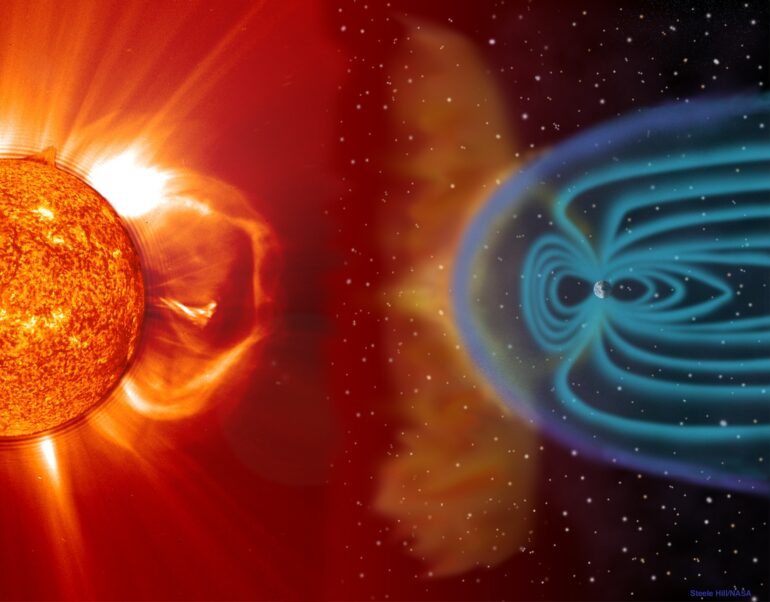
The corona can reach millions of degrees, which is much hotter than the Sun’s surface. In fact, the corona is so hot that the particles shoot out of the Sun, escaping from the Sun’s gravity, engulfing the entire solar system. This stream of plasma is called the solar wind.
The solar wind’s invisible, continuous gust of plasma fills a bubble in space that extends far beyond the orbit of Pluto. It can reach up to 2 million miles per hour (3 million kilometers per hour) – at that speed, the solar wind would take less than a minute to circle the Earth. For comparison, the International Space Station takes 90 minutes to go around the Earth.
While it’s hard to see the solar wind directly in photos once it leaves the corona, we can measure the gas directly with instruments in space. Scientists have recently gotten up close and personal with it by…