Have you ever walked face-first into a spiderweb while on a hike? Or swept away cobwebs in your garage?
You may recognize the orb web as the classic Halloween decoration or cobwebs as close neighbors with your dust bunnies. These are just two among the many types of spiderweb architectures, each with a unique structure specially attuned to the spider’s environment and the web’s intended job.
While many spiders use their webs to catch prey, they have also evolved unusual ways to use their silk, from wrapping their eggs to acting as safety lines that catch them when they fall.
As a materials scientist who studies spiders and their silks, I am curious about the relationship between spiderweb architecture and the strength of the silks spiders use. How do the design of a web and the properties of the silk used affect a spider’s ability to catch its next meal?
Webs’ ancient origins
Spider silk has a long evolutionary history. Researchers believe that it first evolved around 400 million years ago. These ancestral spiders used silk to line their burrows, protect their vulnerable eggs and create sensory paths and guidelines as they navigated their environment.
To understand what ancient spiderwebs could have looked like, scientists look to the lampshade spider. This spider lives in rock outcroppings in the Appalachian and Rocky mountains. It is a living relative of some of the most ancient spiders to ever make webs, and it hasn’t changed much at all since web-building first evolved.
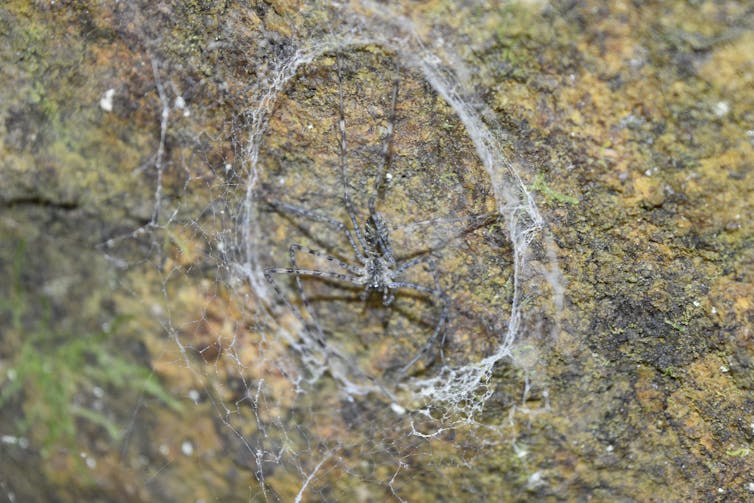
A lampshade spider in its distinctive web between rocks.
Tyler Brown, CC BY-SA
Aptly named for its web shape, the lampshade spider makes a web with a narrow base that widens outward. These webs fill the cracks between rocks where the spider can be camouflaged against the rough surface. It’s hard for a prospective meal to traverse this rugged landscape without being ensnared.
Web diversity
Today, all spider species produce silk. Each species creates its own specific web architecture that is uniquely suited to the type of prey it eats and the environment it lives in.
Take the orb web, for example. These are aerial, two-dimensional webs featuring a distinctive spiral. They mostly catch flying or jumping prey, such as flies and grasshoppers. Orb webs are found in open areas, such as on treelines, in tall grasses or between your tomato plants.
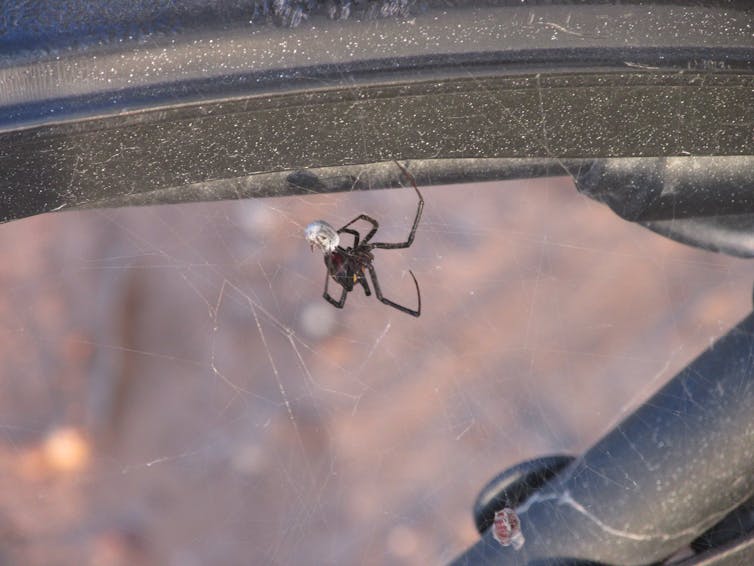
A black widow spider builds three-dimensional cobwebs.
Karen Sloane-Williams/500Px Plus via Getty Images
Compare that to the cobweb, a structure that is most often seen by the baseboards in your home. While the term cobweb is commonly used to refer to any dusty, abandoned spiderweb, it is actually a specific web shape typically designed by spiders in the family Theridiidae. This spiderweb has a complex, three-dimensional architecture. Lines of silk extend downwards from the 3D tangle and are held affixed to the ground under high…