
Delivering a connection-building protein to star-shaped cells in the brain could reverse changes to neural circuits seen in Down syndrome, according to new research my colleagues and I published in the journal Cell Reports.
Down syndrome is caused by an error in cell division during development. Individuals receive three copies of chromosome 21 instead of the typical two copies, resulting in duplicates of the genes encoded on chromosome 21. This trisomy leads to a multitude of changes to heart and immune function as well as neurodevelopmental impairments.
Changes to the structure of neurons in people with Down syndrome alter how they connect with each other. One major type of brain cell called astrocytes helps form connections between neurons. These star-shaped cells have many thin arms that extend into the spaces between neurons. They also secrete various proteins that are vital to forming the proper neural connections necessary for brain function.
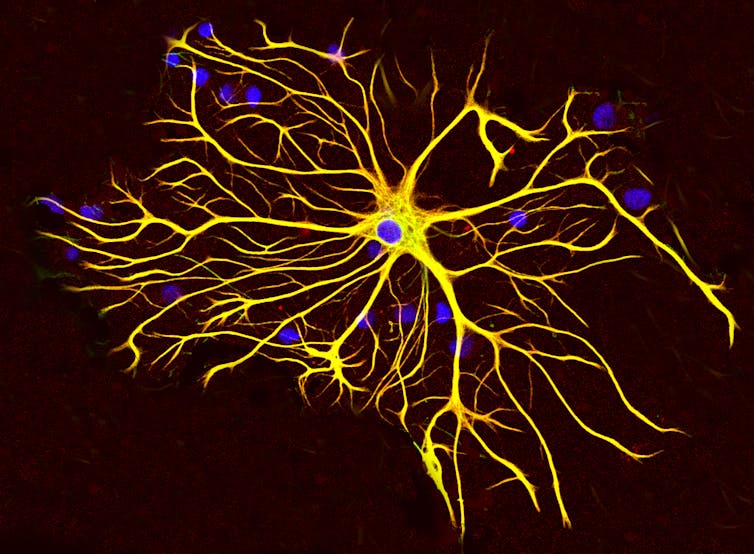
Astrocytes have long extensions that help form connections between neurons.
GerryShaw/Wikimedia Commons
Researchers have found that mouse models of several neurodevelopmental disorders, including Down syndrome, have altered levels of astrocyte proteins during development. My colleagues and I hypothesized that these changes might contribute to the changes in neural connections seen in Down syndrome. Could restoring the proper levels of some of these astrocyte proteins “rewire” the brain?
Identifying an astrocyte protein
First, we needed to pick a candidate astrocyte protein to test our hypothesis. A previous study had identified a list of astrocyte proteins that were altered in a mouse model of Down syndrome. We focused on proteins present in lower levels in Down syndrome astrocytes compared to astrocytes without the condition. We thought there might not be enough of these proteins available to help form neural connections.
Among the top 10 proteins we identified was a molecule called pleiotrophin, or Ptn. This protein is known to help guide axons – long extensions that neurons use to send information to each other – to their targets during development. So it made sense that it might also help neurons form the branching arms they use to receive information.
We found that mice unable to produce Ptn had neurons with fewer branching arms, similar to what we saw in mice with Down syndrome. This correlation implies that proper Ptn levels are necessary to affect neuron branching during brain development.
Restoring neurons in Down syndrome
Next, we wanted to know if delivering Ptn to astrocytes changes neural connections in mice with Down syndrome.
To answer that question, we packaged the gene for Ptn into a small virus with its replication genes removed. Called adeno-associated viruses, these tools allow researchers to deliver genetic material to specific targets in the body and are used for applications like gene therapy. We delivered the…

