
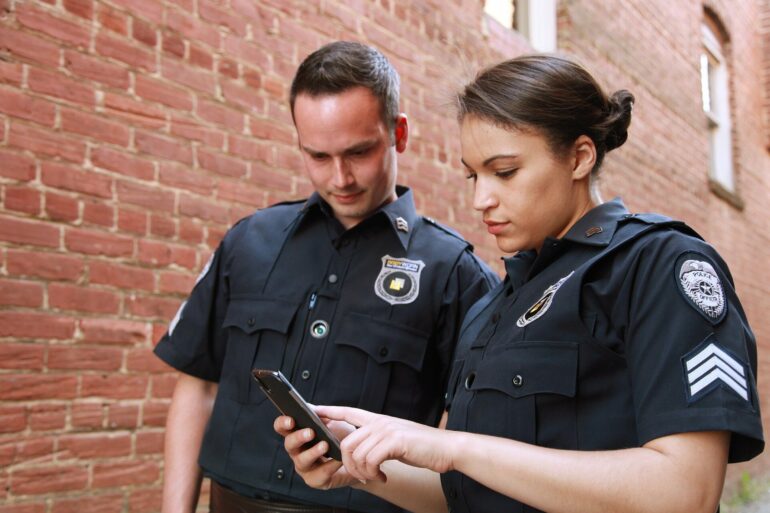
Police are getting a boost from artificial intelligence, with algorithms now able to draft police reports in minutes. The technology promises to make police reports more accurate and comprehensive, as well as save officers time.
The idea is simple: Take the audio transcript from a body camera worn by a police officer and use the predictive text capabilities of large language models to write a formal police report that could become the basis of a criminal prosecution. Mirroring other fields that have allowed ChatGPT-like systems to write on behalf of people, police can now get an AI assist to automate much dreaded paperwork.
The catch is that instead of writing the first draft of your college English paper, this document can determine someone’s liberty in court. An error, omission or hallucination can risk the integrity of a prosecution or, worse, justify a false arrest. While police officers must sign off on the final version, the bulk of the text, structure and formatting is AI-generated.
Who – or what – wrote it
Up until October 2025, only Utah had required that police even admit they were using an AI assistant to draft their reports. On Oct. 10, that changed when California became the second state to require transparent notice that AI was used to draft a police report.
Governor Gavin Newsom signed SB 524 into law, requiring all AI-assisted police reports to be marked as being written with the help of AI. The law also requires law enforcement agencies to maintain an audit trail that identifies the person who used AI to create a report and any video and audio footage used in creating the report. It also requires agencies to retain the first draft created with AI for as long as the official report is retained, and prohibits a draft created with AI from constituting an officer’s official statement.
The law is a significant milestone in the regulation of AI in policing, but its passage also signifies that AI is going to become a major part of the criminal justice system.

If you are sitting behind bars based on a police report, you might have some questions. The first question that Utah and California now answer is “Did AI write this?” Basic transparency that an algorithm helped write an arrest report might seem the minimum a state could do before locking someone up. And, even though leading police technology companies like Axon recommend such disclaimers be included in their reports, they are not required.
Police departments in Lafayette, Indiana and Fort Collins, Colorado, were intentionally turning off the transparency defaults on the AI report generators, according to an investigative news report. Similarly, police chiefs using Axon’s Draft One products did not even know which reports were drafted by AI and which were not because the officers were just cutting and pasting the AI narrative into reports they indicated they wrote themselves. The practice bypassed all AI disclaimers and audit…