
As a Ph.D. student, I wanted to understand the evolution of individual differences in fruit fly behavior – the building blocks of personality. My experiments involved measuring how my tiny subjects acted in a maze.
So each day in the lab began with using a thin paintbrush to lift a single, anesthetized fruit fly and transfer it into a simple maze. After it woke up and had explored the maze, I’d place the fly – careful not to let it escape in transit – back into a tube where it could eat and hang out while I decided its fate.
My labmates and I repeated that process again and again, ultimately measuring the behavior of 900 individual flies daily.
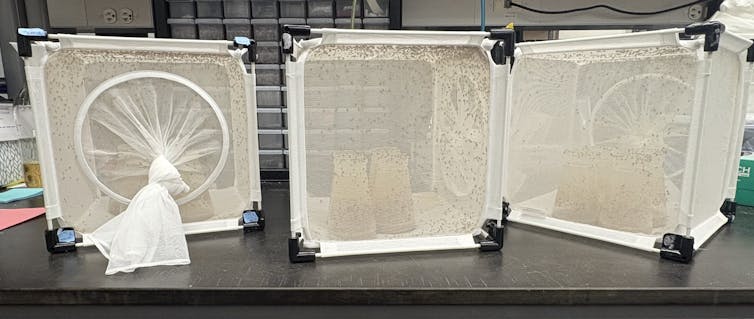
As many as 1,500 flies live in each of these Drosophila population cages. The bottles inside contain the food medium they eat and lay eggs on. Researchers can reach in the side to extract fruit flies.
Shraddha Lall
I listened to countless podcasts and audiobooks over many days of moving lots of flies around by hand and keeping track of their individual identities, but this wasn’t how I’d originally planned this experiment. I had been excited to work with MAPLE, my lab’s robot, to automate the first and last steps of the process. MAPLE would grab individual flies, safely move them into their own tiny mazes, and back out after I’d measured their behaviors.
I’d been trying for months to modify MAPLE’s code. I finally got it running smoothly – and then on Day 1 of my 500-day experiment, MAPLE did not work.
MAPLE hard at work moving flies into Y-mazes.
After a little bit of panic, and a lot of deep breathing, I decided to power through without the robot’s help. MAPLE’s refusal to cooperate was the first of many obstacles I faced as I continued my experiment for the next year and a half. During this time, I learned a lot about the building blocks of personality – as well as the challenges of doing scientific research and how to work around them.
Animals have personalities
As an evolutionary biologist who studies animal behavior, I’m fascinated that no two individuals are completely alike. Think about the animal friends in your life — cats and dogs have unique personalities and idiosyncrasies, whether it’s a specific food they hate or a particular way they like to nap.
All animals – from the smallest worm to the biggest whale – have personalities: individual behavioral preferences that remain more or less stable throughout their lifetime. In Drosophila melanogaster, the fruit flies I worked with, individuality is evident in simple binary behaviors. Individual flies show a preference for turning left or right, choosing a hot or cool environment, preferring brightly lit areas or the shade, and many other idiosyncrasies.
Both nature and nurture influence animal personality. The environment during development can play a crucial role in some instances. In…