
Superconductors—wondrous materials whose resistance drop to zero below a critical temperature—show much promise to meet the growing energy demand of...
Japanese and U.S. physicists have used atoms about 3 billion times colder than interstellar space to open a portal to...
Nuclear magnetic resonance (NMR) is an analytical tool with a wide range of applications, including the magnetic resonance imaging that...

Granular matter is all around us. Examples include sand, rice, nuts, coffee and even snow. These materials are made of...
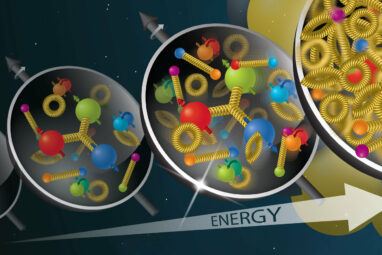
Nuclear physicists studying particle collisions at the Relativistic Heavy Ion Collider (RHIC)—a U.S. Department of Energy Office of Science user...
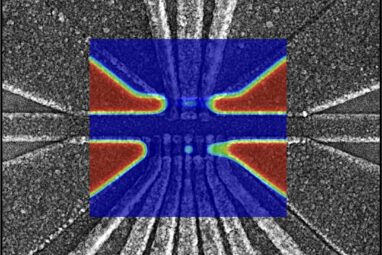
Qubits are the building blocks of quantum computers, which have the potential to revolutionize many fields of research by solving...
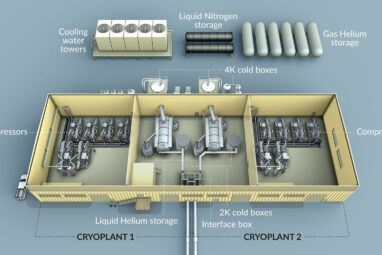
Today it only takes one and a half hours to make a superconducting particle accelerator at the Department of Energy’s...
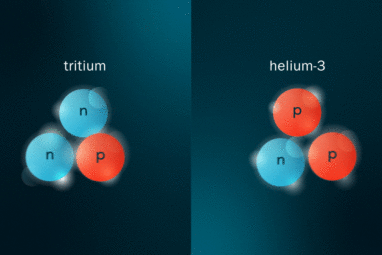
The atomic nucleus is a busy place. Its constituent protons and neutrons occasionally collide, and briefly fly apart with high...
Imagine walking into an airport or grocery store and your smartphone automatically starts charging. This could be a reality one...
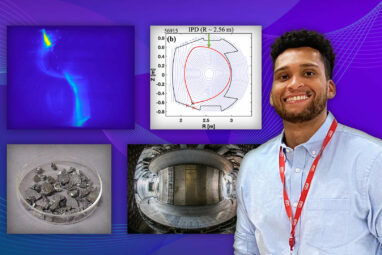
What is the connection between boron, an element in a common household cleaner, and tokamaks, ring-shaped fusion facilities that heat...

A tiny bubble popping within a liquid seems more fanciful than traumatic. But millions of popping vapor bubbles can cause...
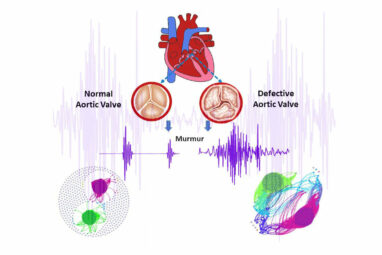
Aortic valve stenosis occurs when the aortic valve narrows, constricting blood flow from the heart through the artery and to...